
I’m back home from the Danube, living regular life in what I’ve always considered to be an old, old house. Built in 1872, it has ten-foot ceilings and narrow closets. It is replete inside and out with spindle work and stained glass. And its floors remind me of what the Austrian architect Hundertwasser once said about old-house slopes.
“The uneven floor,” he said, “becomes a symphony, a melody for the feet.”
But after a trip down the Danube, my house doesn’t seem so old.
“You’ve got to be careful in Europe,” a guide told us. “Lots of buildings here pretend to be old. Don’t be fooled.”
And she explained the sometimes subtle clues that give away true age.
“Look for concrete,” she said. “Concrete wasn’t invented until the mid-1850s. If you see concrete, the building isn’t that old.”
Really old buildings, she went on to explain, have irregular hand-cut bricks and stones, metal gutters, timbered doors, and enough chimneys to heat all the rooms.
But with some buildings, there’s no guesswork. They tell their ages right out.
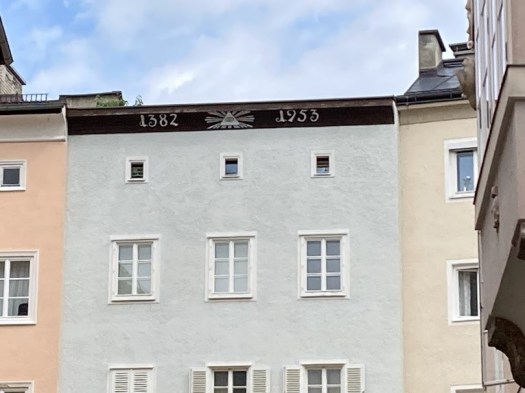
“Watch the roof overhangs,” a guide in Salzburg told us.
And looking up, we could see two dates painted on buildings, the first showing the year it was built; the second showing the year it was renovated.
On our last touring day, we ate in what is considered to be the oldest restaurant in Europe, perhaps in the world. Built in 803, St. Peter Stiftskulinarium fed Christopher Columbus, Michael Haydn, and Wolfgang Amadeus Mozart.

I sat there eating chicken on polenta under a chandelier hanging from a coffered ceiling and tried to take in the years and decades and centuries that together have amounted to more than a millennium.
And that’s when I realized that my house is new after all.
 Apple to Apple