
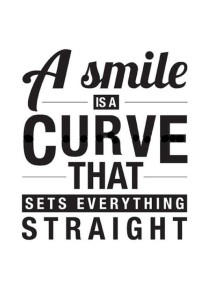
The poster in the dentist’s waiting room conjured up some memories. A smile, it said, is a curve that sets everything straight.
And those words on that wall took me back to the late sixties when Bob Dylan was singing “The Answer, My Friend, is Blowing in the Wind,” and we were all letting it all hang out and telling it like it was.
In my group of friends, we tried to be real—to rid ourselves of the armors our parents had taught us to wear and be completely candid with each other. In this way, we hoped to discover our best selves.
So we’d sit in an honesty circle, maybe twenty of us, and give each other the right to interfere with our lives. One-by-one, we’d speak, each of us telling all of us what we didn’t like about the person to our left.
Maybe this exercise is what wiped the smile off my face. Or maybe it was the war in Vietnam and the riots in the cities and the assassinations. Or maybe I didn’t know how to be a teenager in that time and that place. Whatever the reasons, gravity just seemed to pull my mouth down.
And they called me on it.
Smile, they said in those circles. Get out of your head. Chill. Show some feeling. Hang loose. Quit being uptight. Get a groove. Lighten up.
So a smile became my armor. And though I never want to sit in such a circle again, what I learned helped me then and continued to benefit me years later as I taught.
I found that in the classroom, smiles made good things happen. Smiles won students over and helped me stay positive, even on bad days.
There’s science behind this.
When you smile, your brain gets the message that all is well. This sends feel-good chemicals through your brain, lifting your mood and lowering your stress.
And smiles are contagious. So when students smile back, good things happen to them. And their brains sync for learning.
I doubt my long-ago friends understood this science. But I’m sure they would have agreed with the dentist’s poster—A smile is a curve that sets everything straight.
 Apple to Apple