
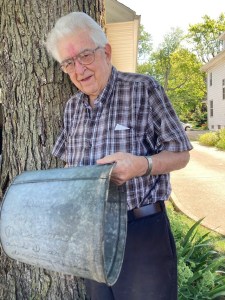
“It was sort of romantic,” my dad says. But he isn’t speaking of my mom, not this time. Instead, he waxes nostalgic about sugaring season, when nights are cold and days are warm and sap rises and it’s time to tap the maples.
In his hands my dad holds a sap pail, one he held a little over seventy years ago. We know this because right there on the pail is a message he scrawled: David is tapping. Oscar Maust and I are driving spiles. Rachel and Alan are handling sap pails. February 19, 1954.
You can find other messages like these on the hundreds of sap pails, also known as keelers, that came from my grandpa’s now defunct sugar camp. On those keelers, you can read about snowfalls and weddings and births. Here are some sample messages from the 1920s:
April 3, 1920—Cousin Olen Miller left for Del. again last night at about 2 o’clock. Yesterday was Good Friday, and the singing was at Uncle Milton Miller’s.
April 20, 1920—Putting away the keelers. Quarantined for scarlet rash.
February 14, 1921—This keeler is at the tree behind the barn.
It was fun, my dad says, to read these words every year as he washed and scalded the keelers and loaded them into the box spring wagon to distribute among the maples.
As I read these messages on the keelers, I think of words I’ve seen carved into school desks and spray painted under bridges and marked on prison walls. I think of Facebook and Instagram, of Tik-Tok and Twitter.
We all, it seems, have the urge to leave marks behind us, to show evidence of having once been alive in a particular place at a particular time.
And I’m happy to now own the sap pail my dad holds in his hands and to hear him remember that time and place.
.
 Apple to Apple