

My brain is too tightly strung, so I go to my garden. It’s a potager, a pocket-size plot that intermingles flowers, herbs, and vegetables—food for the soup pot and beauty for the eyes. And where plants grow up, not out.
The evening is perfect: a white crescent moon rises over our small town, a playful breeze ruffles through the tea, and a hummingbird comes to visit the honeysuckle. Ground cherry plants are just peeping up.

I was six when I decided God’s angels would serve ground cherries at the banquet table in heaven. Healthy candies, that’s what they were, each wrapped like a gift in a papery-thin husk. I sat in my mom’s garden, unwrapping and eating, trying to decide if the taste was pineapple or strawberry or orange. Small wonder that sixty-some years later, I make room for this delicacy in my garden.

Across the brick walkway, I pull a weed from under a rue plant. In Richard II, Shakespeare calls rue a sour herb of grace, linking it with regret. In Hamlet, Ophelia brings an armful of flowers to the royal court. She presents them to the king and queen and gives her flower speech, using each flower to make a point.
“There’s rue for you,” she says. “And some for me.”
And she exhorts the court to wear rue with a difference.
Like it’s my confessional, I bite into the rue’s bitter leaf. And I find comfort in the pairing of sour regret and grace.
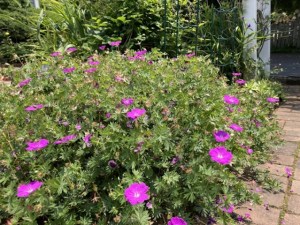
In the next bed, painted geraniums creep onto the path. In Victorian gardens, these plants were placed so their scents would be released when brushed by the skirts of passing ladies. In my garden, however, the scent is most likely released by a stray basketball.
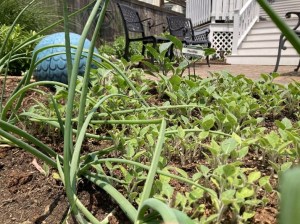
Nearby is the moon flower nursery. The plants are waiting to be dug up, one at a time, and scattered though the garden, where they’ll branch out and up as the sun warms the earth.
Some sultry summer night, I’ll come late to the garden, looking for a breeze blowing in the tea. And bright-white, dinner-plate size flowers will bloom under the night sky. Each bud blooms only once. And only at night. Each flower will be dead by morning. But the next night, new buds will bloom. Angel trumpets, some call them.

My brain will calm as I sit under the moon among the moon flowers. I’ll breathe in the mint and the sharp spices of sage and cilantro and parsley and basil. The night lights will show that tomatoes have grown up their trellises and that squash has covered a v-shaped arbor. I might sample a ground cherry.
And if regrets push into my peace, I’ll think also of grace.
 Apple to Apple
Beautiful! We too plant and love our ground cherries!
LikeLike