
There’s a book that haunted my mom’s childhood. And at 97, her eyes still widen when she hands it to me.
Gently.
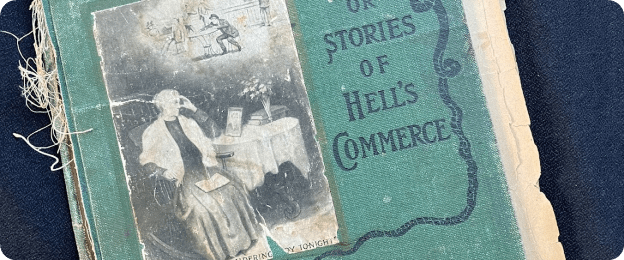
Spine cracked, corners dinged, and pages falling out—it was obviously read again and again. Even though it terrified her.
She helps me turn to the worst page of all. Wanted, says a sign in a drawing, fifty thousand boys, to take the place of the 50,000 drunkards who will die this year.
And below the sign, one poor man after another falls into a bottomless grave, the gateway to hell.
This book, published during the temperance movement is self-described as “. . . thrilling with graphic details and eloquent language of the fearful consequences of the curse of drinking.”
It’s the graphic details that terrorized my mom.
Even though she was exposed to fear from the start.
“Rock-a-bye, baby in the treetop,” my grandma sang as she rocked my mom. “When the wind blows the cradle will rock. When the bough breaks, the cradle will fall. Down will come baby, cradle and all.”
Why do we sing of danger to babies in arms?
And why did the Grimm brothers set out to scare the dickens out of kids?
Children’s literature is replete with horror: wolves lurk in the woods, bears break into bedrooms, giants chase kids, witches cook them, musicians lure them away from home, and birds peck off their noses.
And then there are the poor kids in Shockheaded Peter. Written in the nineteenth century by Heinrich Hoffmann, a psychiatrist, no less, the book is full of bad kids who learn hard lessons. A girl who plays with matches, burns to death; racist boys get dipped in ink; a violent kid is bitten by a dog; a boy who refuses soup, wastes away and dies; and a thumb sucker gets his thumbs cut off with giant scissors.
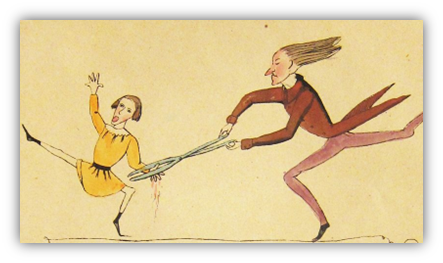
By the end of the book, all Hoffmann’s characters are cured of badness. Or dead.
What’s strange is that kids beg to hear these cautionary tales. They’re curious about scary things. It’s as if they figure a good fright will serve them well, like they’re practicing for life, learning how to manage being scared.
Scary stories warn kids that there’s danger out there. And evil. If not in a forest or castle, at least on the playground or at school or on the streets. And in themselves.
But it’s hard for adults to get scariness right with kids—to provide shivery delight with a manageable amount of fear. I’m not sure Stories of Hell’s Commerce found that balance with my mom.
On the other hand, she’s never had a single drop!
 Apple to Apple
Oh, my stars. This brought a shiver up my back and lit a spark in my brain.
I appreciate the care with which you wrote it. You’ve offered us much in this post.
LikeLike