Scrappy Little Angels

My elderly parents live on a regular street in a typical town, but with a difference. A host surrounds them. Angels but without wings and in the form of ordinary people.

Take the pack of kids who live in some nearby apartments. They’re a rough and tumble bunch—scraped up knees, smudged faces, wild hair, and colorful language. And they’ve got my folks covered.

“Mrs. Miller was in her garden this morning,” a kid on a scooter told me when I pulled into the driveway last summer. “But I watched. She didn’t fall.”

Another kid showed up all summer long, a dandelion digger in hand. “Time to check for dandelions again,” he’d say.

One morning, a girl stood at my parents’ door with a plate of Kroger cookies. She sold one to me, for a quarter. For my mom, the cookie was free.

And it’s not just the kids.

My friends and their neighbors send me texts. An upstairs light was on late last night when I ran by. Your dad is in the driveway picking up branches, looking wobbly. Your mom’s good—stopped by and talked a bit.

My parents live near the hospital. So some of their nurses and doctors take a look as they drive by on their way to work.

“Miss seeing you out in your yard,” my dad’s cardiologist said after a recent EKG. “But I’m glad you’re avoiding the cold.”

There’s a saying we’ve long bandied about, an ancient proverb that came to us from across the world: It takes a village. Usually, we apply this phrase to the care of the young. But the old are also vulnerable. And I’m glad my parents have a village. And one that includes the young.

A bevy of these neighborhood kids came to me one morning with a problem.

“How will we know when they die?” they asked. “We want to come to their funeral.”

And when that time comes, I hope I remember these scrappy little angels.

Erma’s Story

Don’t tell. But this year for Christmas, my dad is giving my mom the best Christmas present ever. He’s invested money in this gift because he’s giving one not only to my mom, but also to his children and grandchildren and great-grandchildren—all 79 of us.

But his greatest investment has been time.

I’ve had a front seat to the writing of Erma’s Story. And what I’ve seen is a labor of love—a gift from my 92-year-old father to my 97-year-old mother, who has long looked for someone to write her story. My dad saw this yearning, so he laid aside what he loves to write—church history—and set to work.

On a spare bed, he laid out the scraps of my mom’s life—diaries, journals, school papers, childhood gifts, photos, scrapbooks, an egg grader, a Hillside Farm butter wrapper, an old feedbag, ledgers, a box of rocks, sermon notebooks, ration books, tattered children’s books, school papers and report cards. Meticulously, he searched through diaries for anecdotes and on newspapers.com for historical facts. He searched through recorded and transcribed tapes for conversations. He created timelines and curated what he found into a coherent and gripping account.

And all this with love.

The same love he’s been showing my mom throughout their daily, elderly lives. I’ve also had a front seat for this, going to their house nearly every day, sometimes multiple times, sometimes overnight. He tucks her in at night—pulling the covers over her shoulders, pushing the play button on her audio Bible, and dimming the lights. He counts her medicine into pill boxes and meets forgetfulness with kindness and generosity.

This is old love, an intimacy built on deliberate decisions to understand, appreciate, and celebrate each other.

As my dad and I sat together for this project, his tenderness for my mother kept bleeding through. When her childhood home burned down and she yearned over a struggling sister and a classmate stole her treasured pencil box, his voice would catch and his eyes glisten. When she and her siblings told stories, he’d throw back his head and laugh. “Such good story tellers,” he’d say. “They know just how to put it all together.” This from a man who is correct, precise, and concise with his diction, admiring the Benders, who bend grammar and syntax to flavor their stories.

Our family will gather as usual this Christmas. We’ll each receive our books, likely autographed with both of their names. And I’m guessing we’ll all learn to sing “Because It’s Christmas Time,” a song found in this book—new to us, but part of our mom’s childhood Christmases.

After the holidays, Dad will go back to writing church history. But only for a season. Health and energy holding, he hopes to get back to Erma’s story. Coming up will be the next season of Mom’s life, including the beginnings of my parent’s romance.

And once again, I look forward to taking a front seat as two distinct plotlines unfold—the budding of young love in the pages of a book and, in the here and gritty now, love that is old.

And flowering.

The How-Are-You Question

The Christmas lights at the hospital caught me unaware. My stomach clenched and my mouth went dry. And no wonder! It’s become an unfortunate trend that when the days grow dark and cold and Christmas lights blink on trees, someone in my family lands in the hospital.

So far, this holiday season, our family is hospital-free, though in different stages of recovery. And a few still grapple with a dilemma—exactly how to answer the question, “How are you?”

This can be an exhausting question, one that generates a plethora of internal predicaments. Is this person saying hello, or really asking? Is this a pain rating of 1 to 10? Is it a lie to give the scripted answer that I’m fine? Just because they ask, do I need to tell? If I answer honestly, will I burst into tears in front of everyone?

The how-are-you question brings pressure. To be good and brave and full of hope. To quickly synthesize a complicated, multi-faceted internal state into a one-word summary. To make an on-the-spot decision about how much to share. To summon the emotional energy to, once again, give a litany of health. 

This is the season of holiday gatherings. People come from afar, people who haven’t seen each other lately. Christmas cheer is in the air. And so is the often-dreaded question—how are you?

So what else can you say in that first moment of meeting?

Here are five ideas:

  • Instead of a question, start with a statement: Great to see you! Glad you made it. It’s been too long since we’ve seen each other.
  • Reflect on shared history: Do you remember the time when we got in trouble together at school?
  • Give a compliment: I love that scarf! That color suits you!
  • Ask about a specific activity: Tell me something about your work, about your kids, about a book you’ve read or a movie you’ve seen.
  • Acknowledge illness with a specific approach: I know you’ve been in the hospital lately. And I’m sure sorry about that. I bet you’ve developed some ideas about what makes a good nurse. I’m curious what you think.

The how-are-you question isn’t always wrong. It can launch strong, empathetic, important interactions. But only when the time is right. And the place. And the relationship.

Perhaps the most important gift you can give to those struggling with health this holiday is the often-hard-won gift of thought. How can your first greeting show someone she’s more than a diagnosis? What topic of conversation could bring the two of you together?

And to make your gift richer, end your talk with a hug and by saying you care. This shows you think about their fight for health, that you are with them, and that you are willing to listen. But all without pressure.

Cursive Comes Back

“I can’t read this kind of writing,” my grandson says, handing the recipe card back to me.

He’s a smart kid, my grandson. But he can’t read the directions for the turkey stuffing we’re making. His aunt wrote them by hand. And in cursive.

“I need help reading cursive, too,” another grandson says. “After all, I see it only once a year—in  the birthday card I get from Great-grandpa.

That’s my dad. He systematically and faithfully writes a card for each of his children, grandchildren, and great-grandchildren and all the spouses they’ve grafted into the family. This is 79 cards per year. And all in cursive, except for preschoolers. He prints for them.

The reading would be easier if my mom wrote the cards. She learned cursive in Pennsylvania, where penmanship was taught the right way. Not in Maryland where my dad went to school. His scrawl stands as her evidence of that state’s inferior instruction.

My mom’s fourth grade penmanship lesson

But even my mom’s flowing script gives her great-grandkids trouble. And they are not alone. Only about half of Americans born after 1990 can read cursive.

This illiteracy, however, is changing. In 2016, Arizona led the way, requiring cursive writing instruction by the end of fifth grade. Since then, about half of US states have followed.

And no wonder! Research shows the benefits. Cursive writing improves fine motor skills and hand-eye coordination. But it does more. It gets the entire brain working—neurological pathways activate, the right side of the brain lights up, and synapses connect.

Even in college, cursive helps. Researchers have found that notetaking in cursive helps students recall more information than when they take notes by printing or on a laptop. It’s as if cursive writing produces not only a flow of words on paper, but also a flow of thoughts in the brain.

A flow my grandkids miss when they can’t read an aunt’s recipe or their great-grandpa’s birthday message.

But there’s hope. At this year’s end, my dad will have written 79 cards. Next year the number will grow. The great-grands keep coming. And starting school. And the most recent batches are learning cursive.

Hopefully, they’ll learn fast enough to read my dad’s birthday cards before they stop coming.

A Thanksgiving Etiquette

It’s going to be a wild and woolly Thanksgiving. Thirty-some people. Shoes stacked  at the door. Coats piled on the study desk. Babies in highchairs. Nonagenarians with canes. Bleary-eyed college kids with papers due despite the holiday. And a general buzz of overlapping conversations.

And just at this moment, my mom gives me a book—The Complete Book of Etiquette by Amy Vanderbilt. It’s an old book. And well worn. When I was a kid. I read it as I ate my breakfast toast. And as I rocked a little brother to sleep. And when I went to bed at night.

Vanderbilt took me to a different world—away from balled-up socks on the living floor and everlasting racks of dishes to dry, and bathrooms where someone, once again, forgot to flush.

She took me to fine living—where people changed for dinner and ate in courses and the hostesses “turned the table” by ending a conversation with the guest on her right and beginning one with the guest on her left. I learned where to place the salad fork and the seafood fork and the meat fork. And the soup spoon and ice-tea spoon.

The book covered how to interview servants and introduce them to the household and manage their work. But I doubted, somehow, that I’d ever have servants to manage. So my favorite chapter was “Gracious Living Without Servants.”

Use all the new appliances, Vanderbilt advised such unfortunate readers in her 1951 book. And work ahead to avoid hurry and tension. She even offered menus for maid-less meals. In such a luckless life, there was still hope.

When did I stop dreaming of china and goblets and touching a bell for service?

I can’t say. But I can tell you that in a few days I’ll set a stack of 30-some plain white Corelle dinner plates at the beginning of a buffet where guests will serve themselves turkey from crockpots and dressing and vegetables from baking dishes.

This doesn’t mean I’ve stopped dreaming. My holiday visions now are of a ninety-seven-year-old great-grandma talking with my 17-year-old grandson, of a hug someone gives a sister in cancer treatment, of young treble voices and old tremulous voices and all the voices in between singing “I Thank the Lord my Maker for All his Gifts to Me.”

The Stitching of a Life

The first snow blankets my garden. Gone are the slate markers and ground cherries and painted geraniums. The tomato and squash trellises are stacked in the garage. And a brown paper sack of moon flower seeds hangs to dry for next spring’s planting.

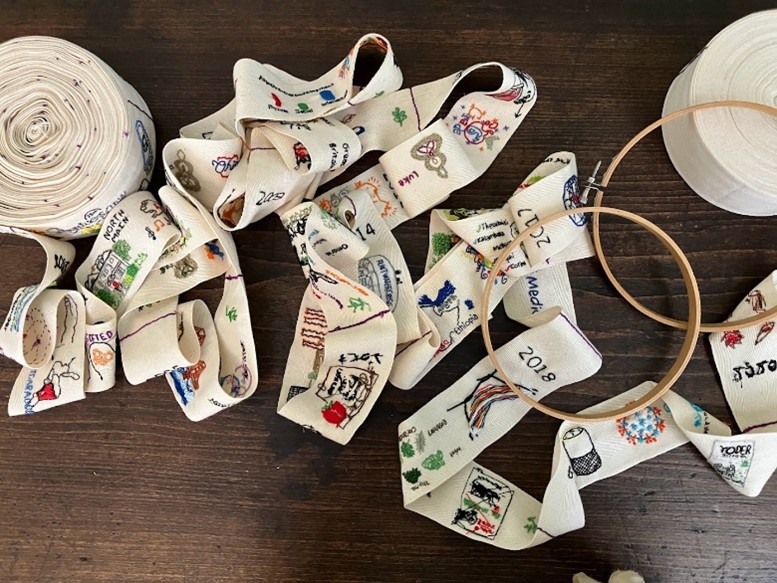
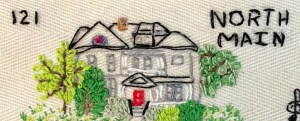
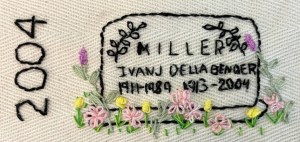
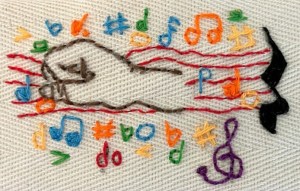
But for maybe the first time, I’m not sad. I’ve got something for my hands to do this winter, something not related to a keyboard. I’ve returned to my autobiographical embroidery project, my reward at the end of a day of writing and caring for parents. Last year, I wasn’t sure. Would this project work?

It’s working.

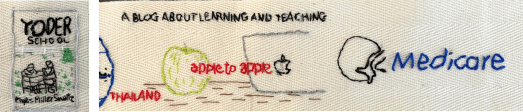
Last winter I stitched through my childhood—remembering Herman the duck, Jersey cows, the horror of burnings at the stake as I leafed through the Martyrs Mirror, my beloved Yoder School, and jumping rope.

I finished my teenage years—the peace symbol, the Vietnam War, the Watergate scandal, dating Steve, and graduating from high school.

As I stitched I listened to audio books and documentaries and book reviews. And I remembered—how we went to college after we had kids, how our honey bees paid our tuition, and how we were so poor that we ate turkey drumsticks every Sunday lunch and cornmeal three ways: mush, bread, and porridge.

I stitched the births of my two children and the deaths of my grandparents—three of them in a just a little over a year.

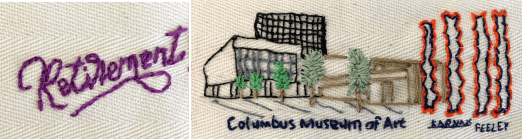
I moved through my college years and graduate classes, stitching diagrams to show what I learned, and where.

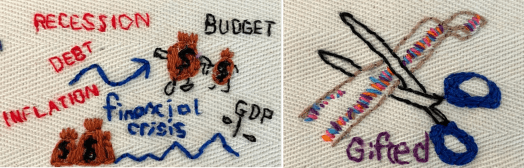
And I stitched through the busy years of teaching—middle school writing and literature, a gifted program, prison classrooms, college, and parent education.

And by the end of the winter, before rhubarb pushed crinkly, succulent, red and green leaves through the garden soil, I had come to the end of the twentieth century when I was smack in the middle of my life, that is if I have my parents’ longevity.

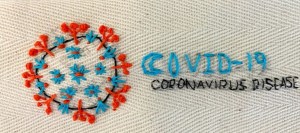
By now, I’ve also lived through a quarter of the twenty-first century, meaning I’ve got two-and-a-half decades of embroidery to catch up to myself. At three images per year, this is 75 images to go.

But for once in my life, I’ve got a project without a deadline. And I’m going to enjoy every stitch.

Grim Stories

There’s a book that haunted my mom’s childhood. And at 97, her eyes still widen when she hands it to me.

Gently.

The Curse of Drink or the Stories of Hell’s Commerce

Spine cracked, corners dinged, and pages falling out—it was obviously read again and again. Even though it terrified her.

She helps me turn to the worst page of all. Wanted, says a sign in a drawing, fifty thousand boys, to take the place of the 50,000 drunkards who will die this year.

And below the sign, one poor man after another falls into a bottomless grave, the gateway to hell.

This book, published during the temperance movement is self-described as “. . . thrilling with graphic details and eloquent language of the fearful consequences of the curse of drinking.”

It’s the graphic details that terrorized my mom.

Even though she was exposed to fear from the start.

“Rock-a-bye, baby in the treetop,” my grandma sang as she rocked my mom. “When the wind blows the cradle will rock. When the bough breaks, the cradle will fall. Down will come baby, cradle and all.”

Why do we sing of danger to babies in arms?

And why did the Grimm brothers set out to scare the dickens out of kids?

Children’s literature is replete with horror: wolves lurk in the woods, bears break into bedrooms, giants chase kids, witches cook them, musicians lure them away from home, and birds peck off their noses.

And then there are the poor kids in Shockheaded Peter. Written in the nineteenth century by Heinrich Hoffmann, a psychiatrist, no less, the book is full of bad kids who learn hard lessons. A girl who plays with matches, burns to death; racist boys get dipped in ink; a violent kid is bitten by a dog;  a boy who refuses soup, wastes away and dies; and a thumb sucker gets his thumbs cut off with giant scissors.

By the end of the book, all Hoffmann’s characters are cured of badness. Or dead.

What’s strange is that kids beg to hear these cautionary tales. They’re curious about scary things. It’s as if they figure a good fright will serve them well, like they’re practicing for life, learning how to manage being scared.

Scary stories warn kids that there’s danger out there. And evil. If not in a forest or castle, at least on the playground or at school or on the streets. And in themselves.

But it’s hard for adults to get scariness right with kids—to provide shivery delight with a manageable amount of fear. I’m not sure Stories of Hell’s Commerce found that balance with my mom.

On the other hand, she’s never had a single drop!

The Times They are a-Changing

We’re sitting in retired bliss, windows open to catch the last warm breezes of fall, recliner footrests up, and  books in hand, when into the rustle of turning pages comes someone else’s music. Likely a cool young teenager sauntering down the sidewalk with a boombox, sharing his tastes with the neighborhood.

He gets closer. And it hits us at the same time. That’s Bob Dylan! That’s our music out there in the cool kid’s boombox, lyrics our generation sang to our parents when we were young and cool:

Your old road is rapidly agin’
Please get out of the new one
If you can’t lend your hand
For the times they are a-changin’

Along with four-part harmony at church, this folk music with its simple words, sing-along vocal styles, and lyrical messages of peace, love, and social justice was the music of our youth.

After dates, Steve would drive me home in his 1967 Buick Special. He’d turn the radio dial to catch Peter, Paul, and Mary singing about hammering out justice. Or John Denver about leaving on a jet plane. Or the New Seekers about the world standing hand in hand.

Steve would reach for my hand, and we’d drive through Flint down Saginaw Street, wishing the evening would never end.

The cool kid on the sidewalk takes us back to those years, that long-ago time when we were building our identities, finding who we were. So no wonder the music from his boombox grabs us.

But this isn’t just nostalgia. In education, we call it the reminiscence bump. Adolescence and budding adulthood are times of rapid change, heightened hormones and emotion, and cognitive fitness—all ideal conditions for storing memory.

During this time, the books we read, the sports we play, and the movies we see stick with us. But especially the music we hear. Music prompts the brain to release dopamine and oxytocin—the same chemicals that are triggered when eating chocolate cake or taking a nap or driving down Saginaw Street with a boyfriend.

Put hormones and music together, and you’ve got something to remember.

The other week, Steve made his first playlist ever—Bob Dylan, Johnny Cash, Glen Campbell, the

New Seekers, the Byrds, Simon and Garfunkel, and Peter, Paul, and Mary.

On the way to visit grandkids in college this last weekend, we drove back to Michigan. And going up Route 68, we listened again to Dylan’s “The Times They are a-Changin’.” And Steve reached over to take my hand.

I don’t know what he was thinking, but here’s what I was hoping—that, “though our old road was rapidly agin’,” we’d still be able to  “lend a hand” to our college grandkids.