Feuds at the Kitchen Sink

The most bitter feuds of my childhood took place at the kitchen sink. Getting along with siblings can be tough in any setting, but especially when you work just inches from each other in a cook-from-scratch kitchen that feeds nine people three times a day.

We soldiered through stacks of plates and mounds of pots and pans, each of us assigned a job: scraping, washing, rinsing, drying, putting away, and sweeping under the table. As the wash water darkened and tea towels dampened, we issued forth a barrage of complaints–scraped dishes still gunky, washed dishes dirty, rinsed dishes soapy, dried dishes crowding the counter. Someone was sure to be sniffling or whistling off key or making faces.

But this was only some of the time.

Other times it was us against the dishes. Shoulder to shoulder, we tackled a messy kitchen . . . and more. With eyes on the dishes, it was easier to talk about what it was like to be the only Mennonite kid in our classes, how we could cope in the year 1984 when Big Brother would be watching, and how infinity could go on and on and on. Perhaps the simple, repetitive nature of washing dishes gave us the courage to admit our angst.

Those may have been the good-old days. But these days, I’m grateful for a dishwasher. During our family’s staycation this summer, the fourteen of us each loaded our own plates into the dishwasher. And while it washed and rinsed and dried, and achieved a level of sanitation far greater than that of the long-ago kitchen, we played Frisbee golf and visited a cave and coerced the grandchildren into reading at a poetry slam.

Troubled thoughts didn’t stop when people found they could survive 1984. There’s still infinity. And the feeling of standing alone. And adults coercing cool teens into poetry slams.

But I’ve seen my grandchildren pound out anxieties on cross-country trails and basketball courts. I’ve heard them in deep discussion on late-night road trips in dark vans. Dishwater isn’t the only place to shed angst.

Fifty Years and Not Unscathed

It was surreal. Fifty years before in this very room, we had signed each other’s yearbooks. And here we were again, in the best possible venue for a half-century class reunion—our high school cafeteria with the same old floor tile and the same old windows tilted open to catch a breeze that still wasn’t there.

We were not unscathed. We had lost muscle and vision and memory and health. We had lost spouses through death and divorce and dementia. We had taken career hits, many when General Motors pulled more than 70,000 jobs out of Flint. And we had lost classmates through cancer and accidents and murder.

I hadn’t been one of the cool kids at Bendle High School, but at this reunion, they made me feel cool.

“You might remember me,” I told everyone when I introduced an icebreaker, “as the little Mennonite girl with long skirts and long hair and a covering on my head.”

As I expected, I saw recognition dawn. But what I hadn’t expected was all the warm hugs from all the cool kids.

We had nothing to prove in the cafeteria that day, no need to brag, nothing to show off. We were content to just sit with each other, to share memories and renew friendship.

Brian and Sue and I had a conversation. Now all retired, one of us had been a police captain, one a casino blackjack dealer, and one a teacher—all jobs with high risk for conflict.

“How did you de-escalate?” one of us asked.

The dealer spoke first: “I killed them with kindness.”

That’s it, I thought. That’s what we’ve learned in fifty years. That’s what I feel in this high school cafeteria on this day.

What mattered had changed. Dunking baskets and running 100 yards had shrunk to size. So had class standing and victories on the homecoming court.

What mattered now in this room was kindness.

Reading Suppers

Swanson’s new TV dinners had nothing on my mom. Not owning a television, we didn’t peel back the foil to eat a pre-made Salisbury steak in front of “I Love Lucy.” And though we were jealous of kids who did, we had something better—reading suppers.

On evenings my dad was out of town, we’d troop to the table, the seven of us, with a picture book or a Hardy Boys mystery or The Diary of a Young Girl. And after saying grace for the mashed potatoes and meat gravy, we’d fall into a silence that was usually broken only by the turning of pages and the scraping of forks.

Occasionally, one of the little kids would chuckle over The Cat in the Hat. Or someone would look up from the latest Guinness World Records to ask if we all wanted to see a picture of the tallest man in the world. Sometimes we’d hear someone chuckle or sigh or say, “Please pass the potatoes,” but these interruptions were usually ignored and certainly not applauded.

My mom would glance up from her book now and then. And as she trailed her eyes around the table, she’d look downright pleased with herself. As a child, I thought she was delighting in our literary gain.

But years later on a cranky summer evening when my own kids had nothing nice to say, I got an idea.

“Guess what!” I said to my kids, and I sent them for books.

As pages turned and bickering stopped, I understood that long-ago smugness on my mother’s face.

But my mother gave me more than a tool for grumpy kids. She also showed me how to compound joys. So since I’ve retired, I bring two things to my daily lunch—a sandwich and a book.

“Eating and reading,” C.S. Lewis said, “are two pleasures that combine admirably.”

Is the Universe a Friendly Place?

“Is the universe a friendly place?”

Some people say Einstein asked this. Some say he didn’t. Either way, it was good question for me.

When I came up against a daunting class of middle schoolers or inmates or the highly gifted, my first instinct was to keep myself alive. Convinced the class was full of students out to get me, I’d build my defenses and scan for trouble.

Sullen faces, knowing looks, shuttered eyes, closed books—I noticed all this and expected the worst.  

My clenched gut was a clear answer to Einstein: The universe was not a friendly place.

But in an unfriendly place I couldn’t teach, not really. There was no curiosity, no marvel, no weaving of magic. And no learning, not real learning.

To truly teach, I had to foster love and forge peace. I had to look for the right, not the wrong.

Each time I switched to this focus, something happened. I began to notice small, everyday miracles—the lifted chin of an adolescent on the first day back after his mother’s funeral, the suspiciously bright eyes of an inmate as he asked what teenagers need from a father, the catch in the throat of a science geek who told me she had just discovered her life calling, to study black holes

To be sure, trouble still bubbled up. The lives of many students are messy and filled with pressure and pain. But when trouble came, I learned to first assume the best, not the worst. And even in the worst, to assume there was more to know. And this sucked the power out of trouble.

As I learned all this, my answer to Einstein began to change. The universe was a friendly place.

At least some of the time.

No Words This Week

And these photos show why:

Eating with Great-Grandparents
Eating On the Go
Biking
Learning About Anabaptist History
Walking
Taking Risks
Reading
Hanging Out
Folding Laundry
Riding Roller Coasters

The Most Wonderful Time of the Year

They’re coming. They of the ferocious appetites, who prowl through the kitchen two hours after a meal, who chug milk by gallons and devour hamburgers and pasta and eggs and bread and, actually, vegetables.

For the past seventeen summers, they’ve descended on us. This used to mean changing diapers and tying on bibs. In those first years, they were easily entertained with backyard sprinklers and Plasma cars and Razor scooters. For hours they painted with water—the walls of the garage, the picnic table, the doors all around the house—and marveled at their handiwork. They colored pictures as we told Bible stories.

They went to bed early back then, and shook us awake at the crack of dawn. During their long afternoon naps, we’d catch our breath. Now we can breathe long into the morning. Their internal clocks now hold them to their cots. And as they sleep on and on, their pituitary glands release growth hormones. The tables have turned. Now it is our turn to shake them awake.

They may slog through their mornings. But at what is our usual bedtime, they become fully alive. And if we want them to talk with us, we need to adjust to their schedule. It’s like we change time zones without leaving home.

We’ve traded in Plasma cars for roller coasters and kayaks for sprinklers and crayons for discussions on how to bring a bit of heaven to earth. We take them to outdoor dramas—this year Trumpet in the Land, the story of the brutal massacre of 96 pacifist Moravian Delaware Indians by an American militia. And we cook together and do dishes and visit their great-grandparents, just three blocks away.

Cousin Week, I know, won’t last forever. We’re headed for our dotage and they for adulthood. But for this time of life, Cousin Week, for me, is the most wonderful time of the year.

My Nonagenarian Parents Take a Road Trip

If you’re losing hope in humans, try taking my parents on a road trip. Both in their nineties, they don’t travel often. So you’d have to find a good reason to entice them to pack their bags.

Last weekend held the best of reasons—the Benders were gathering. When my Grandpa Bender married my grandma, he wanted twelve children. He didn’t get his wish. My mother was one of only eleven. But he might have been satisfied to know the most recent tally of his family: 11 children, 55 grandchildren, 165 great-grandchildren, 274 great-great grandchildren, and 34 great-great-great grandchildren, for a total of 539 offspring.

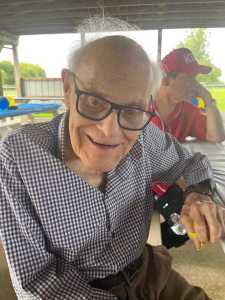
Of all these people, my mother, at age 94, is the oldest living descendant. And last weekend, she was determined to fill her matriarchal role by showing up at the reunion.

So we packed pills and pillows and warm wraps and a cane and headed east, toward the mountains of Western Maryland.

Benders enjoy telling a good story and laughing and eating. Most of all, they take joy, deep joy, in people. They watch babies’ faces and chuckle over toddlers’ antics and applaud as teenagers try their wings. And to grow old among the Benders is to receive deference and honor. So I knew my parents were making their way toward kindness.

What I didn’t expect, though, was so much kindness along the way.

To keep blood flowing and joints limber, we stopped every hour. And at each rest break, kindness practically sprang forth.

People stopped their cars to let us cross parking lots, leapt to open doors, and waited patiently as we blocked their car doors in order to help our parents hoist themselves back into the van. Once at McDonalds, the restroom was crammed with high school girls talking over each other, scrolling on phones, and comparing shades of lipstick.

My mom stood in the doorway, taking it all in, wandering how she’d ever make it through the crowd.

One girl recapped her lipstick.

“Good morning, ma’am,” she said.

And the Red Sea seemed to part. Girls practically fell over each other as they stepped back to give my mom passage to the front of the line. A smile was on every face, including my mom’s.

“Tell me where you’re all going,” my mom said on her way out.

So they stood there talking, my mom with her wrinkles and these freshly made-up girls, who had paused their scrolling.

It was almost like we were already with the Benders.

Just One More Day

I felt a panging last week, one I didn’t expect. Afterall, I’m glad to be retired. I’ve not missed high-stakes tests and staff meetings and 4:30 A.M. alarms. But the morning I read about the walking classroom, I wanted to teach again.

Why hadn’t I thought of this idea?

It’s not like I didn’t have the theory. In college, I read John Dewey, who said students learned by doing. In graduate school, I studied Howard Gardner, who said there were multiple ways to learn, one of them using the body. And at a conference on brain research, I saw proof that brains work better when bodies move.

So I tried.  

I broke study sessions into chunks with exercises breaks. And when I saw eyes glaze over, I invited the class to stand up, breathe deep, and shake it off.

This helped. The exercise instantly woke the sluggish. It got their circulation going, moving blood from legs, where it had pooled, up into brains, where it could do some good.

But the conceivers of the walking classroom take it further. Instead of alternating moving and learning, they bring the two together. It’s a simple pairing of an old-fashioned walk with modern technology.

Through buds in their ears, students listen to podcast lessons as they walk. The part of the brain that makes the body move also brings about learning. So on this listening walk, double the neurons are popping, and brains are flooding with feel-good chemicals.

Students don’t know all this, of course. They just think it’s a fun way to learn. And, on test days, they appreciate how these lessons stick.

I’ve long known that, for some students, movement is a must. But the walking classroom recognizes that it matters for all.

If only I could have one more day in the classroom . . . but without a 4:30 alarm.

It Happened Again Last Week

It happened again last week. To each of us. At a store, someone asked me for help. And at a restaurant someone thought my husband Steve was a celebrity.

“Are you actually John Ritter?” a waiter asked. And he pulled up a photo on his phone to show us the likeness.

When we visited Boston one summer, people approached Steve three times asking if he was a Kennedy.

But mostly they want to know if he’s Robert Redford, the last time being this spring after a hike at the Clifton Gorge, right here in the middle of small-town Ohio.

I’ve never once been mistaken for a movie star. But I am in demand.

“Excuse me, ma’am,” people ask in Macy’s, “Could you tell me where to find a size seven for this shoe?”

At the library, they want me to point them toward the biographies. At Home Depot, they ask for brass pipe fittings. At the history museum, they can’t find the Civil War exhibit.

Maybe it’s because I’m a teacher. I was taught to walk tall and stand confidently, especially when I felt like shrinking back. Your lesson begins, my mentor told me, the moment your students set eyes on you. This first, immediate impression can shape your semester.

My students at the middle school and the prison and the gifted program all affirmed what my mentor said. Not in so many words. But it was clear. On the days I walked into class, closed up and collapsing into myself, they were glad to take up the space. And those were not good days.

But on my expansive days, when I was open and free, when I stretched out across the class, students gave me the room I needed to teach.

In this way, I learned to walk the classroom aisles.

And this apparently generalized to the aisles at Macy’s and the library and Home Depot and the history museum.

I must be losing this bearing, though. It’s not happening as often. And I’m becoming surprised when someone says, “Excuse me, ma’am.”

But I hope celebrity spotters keep finding Steve. Given my work-a-day, ordinary life, it’s entertaining to hear someone ask my husband if he’s Robert Redford.