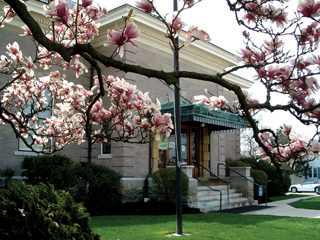
Too Good to be True

It’s too good to be true. I can’t believe I can walk three blocks down and one block over and be at my favorite building in town. And all because of Andrew Carnegie, who was once the richest person in America.

But also because of James Anderson.

Before Anderson stepped into his life, the young Carnegie could only dream of reading books. He was then a thirteen-year-old bobbin boy working in a cotton mill from dawn until dark, earning $1.20 a week. He couldn’t buy books. And he couldn’t pay the $2 subscription to the local library, where working folk like him weren’t welcome, anyway.

But when Anderson opened his personal library to working boys, Carnegie showed up. Each Saturday afternoon, he returned a book he had borrowed from Anderson’s 400-book collection. And after he and Anderson discussed the book, Carnegie chose his new book for the week. Anderson’s books—volumes like Lamb’s essays, Bancroft’s History of the United States, and Shakespeare—provided most of Carnegie’s education.

After Carnegie made his fortunes, he remembered the wonder of those Saturday afternoons with Anderson and his books. And between 1886 and 1919, he donated more than $40 million to build 1,679 new libraries in communities large and small across America. Each library was built on two conceptual pillars. They were public, and they were free.

One of these Carnegie libraries is four blocks from my house. My son worked there through high school, shelving returns and helping patrons find books. I served on the library board for seven years, during the time computers were coming in and whispering was going out.

But though I sat though nearly a hundred board meetings, I’ve never lost the wonder of walking through the library door. I like the muffled rustle of turning pages and the rows of shelves holding hundreds of books—old leathers with flaking gold lettering; new with glossy dust jackets, paperbacks holding each other up, tall books and skinny and short and squat. I like breathing in the scents of paper and dust and ink.

In these books I find friends and advise and information. I can run may fingers over their spines and pull out this one and that. I can pick up any one of these books and take it home.

It’s too good to be true.

And I thank James Anderson and Andrew Carnegie.

How To Grow Eyes in the Back of Your Head

“I wouldn’t do that if I were you.”

This is what Mr. Weber was saying to his students just as I walked into the back of his mostly-settled classroom.

What he said made three things happen. Holly pocketed the note she was about to pass, Jennifer stuffed a unchewed stick of gum back into her bag, and Josiah crumpled the straw he had smuggled from the cafeteria to use as a paper-wad launch.

How could Mr. Weber have known about the straw launcher and the gum and the note? His back to the class, he had been writing an algebraic equation on the chalkboard.

It turns out, he hadn’t known.

“I just sensed something in the air,” he told me later. “I figured my warning would land justly on someone.”

Having eyes in the back of your head—this is what students call this uncanny ability to be aware of what seems to be hidden.

Educators call it “with-it-ness.”

Effective classroom management, Mr. Weber taught me, is not so much how teachers deal with misconduct as how well they prevent it.

Mr. Weber used a lifeguard approach. Lifeguards are trained to spot early signs of danger: panicked looks and flailing arms and vertical positions. And by acting in good time, they forestall crisis.

So how can teachers grow eyes in the backs of their heads? Here are some strategies I learned from Mr. Weber:

  • Watch as students’ faces as they enter. Then respond to what you see. The squeeze of a shoulder, the offer of a corner nook, a calming word, a note dropped on a desk, all these can avert trouble.
  • When you can, keep turned toward the action. When Mr. Weber conferenced with a student, he positioned himself so he could see the rest of the class. When students were testing or writing, he sat at the back of the room, where his eyes were on them and theirs weren’t on him.
  • Move throughout the classroom. Never knowing where Mr. Weber would show up, students stayed engaged instead of acting up.

Mr. Weber might have been known for the eyes in the back of his head. But when students talked about him, their voices held more admiration than grumble.

The Day I Pretended to be Bad

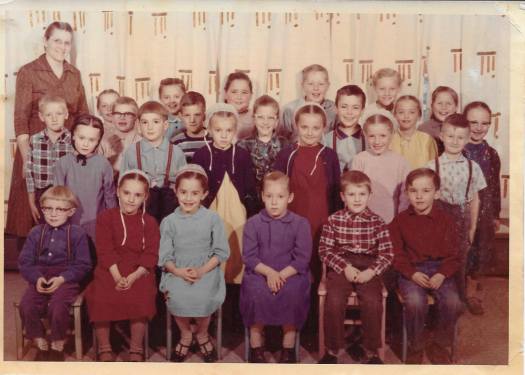
Friday afternoon stretched endlessly in Mrs. Lott’s third-grade class. Flies droned on the window sills. I watched the secondhand tick past the minute hand, and I squinted my eyes trying to catch the hour hand move. I had already written each spelling word five times each. And now I was copying page after page of math problems from the textbook onto my paper, solving the same kinds of calculations over and over again.

Still, I tried to be good. My parents wanted me to follow the rules. And besides, Mrs. Lott had an end-of-class ritual. Each day when the closing bell rang, she stood in her doorway with a paddle in one hand and a dish of M & M’s in her other hand. Every kid left her room with a swat from the paddle or a good pill from the candy dish. Some kids, like Judy Hadley, who sat across the aisle from me, got the paddle every day.

Even so, I envied Judy. Her afternoon had been far livelier than mine. Having just shopped at the Judd Road party store, she had munched through a box of Lemonhead candy and was now chomping on a mouthful of Bazooka gum while she surreptitiously parceled out hot cinnamon toothpicks to her friends. When Mrs. Lott wrote on the chalkboard, Judy talked and passed notes. And she created a mess in the aisle by stuffing so many papers into one side of the book box under her seat that they fell out the other side.

I was watching her use the tip of her scissors to etch a design on the back of her math book, when I got an idea. I could liven up my afternoon by pretending to be bad. I didn’t really chew gum, but I moved my mouth like I did. I didn’t carve a design on the back of my book. But I sketched one with a pencil and then erased it. I didn’t actually talk to Frank Adkins, who sat behind me. But I turned around and pretended I did. I began to see why Judy was bad. Being bad made the end of school come faster.

The dismissal bell rang. That’s when I remembered the good pills and the paddle. I could hardly breathe. When I stood up, I thought I would fall down. Somehow, I got to the door. For a terrible moment, Mrs. Lott looked at me.

“For the first time,” she said. “I’m not sure what to do with you.”

I waited.

Then she gave me a good pill.

I was never bad for Mrs. Lott again.

(For more stories like this, read my memoir—Yoder School.)

He Can’t Believe I’m Still Alive

He towered above me in the Kroger parking lot, a smile sweeping across his face.

“Mrs. Swartz!” he said. “I wasn’t sure you’d still be with us.”

And then, having heard his words, began sputtering around as his brain searched for a way out.

“I mean,” he finally managed. “I thought you might have moved out of town.”

Jerome had been a wistful sort of student, never quite sure he’d make it onto the basketball team or through the midterm exam or into a group of friends. But he had also been dogged, trying against the odds.

Now he stood beside what looked to be a luxury pickup truck, as well-kept as his scuff-free boots and chino pants and fleece-lined cargo jacket.

Jerome worked in construction, he told me. And on the side, he bought houses and flipped them. He was working on his third house. The money from these houses went into the bank as a foundation for starting his own construction business.

He shook his head in disbelief, and a look of wonder came across his face.

“I’m doing it,” he said to me. “I’m making a good life.”

It’s something to get a strong hug from a hulking young man who used to sit so timorously in the back of my class.

I wish he could have had a glimpse back then of the assured adult he was at this moment in the Kroger parking lot. But probably it was the struggle against the unknown that made him this strong.

Just as he left, Jerome again showed his true colors.

“Goodbye, Mrs. Swartz,” he said. “Glad you’re still here!”

Knowing that kid, he’ll probably keep checking for my obituary.

I’ve Been Called Worse

“You know what, Grandma?”

Jesse and his brothers had just spent his spring break at our house. As we headed back to their home in Illinois, he cast an appraising eye toward me from his seat in the van.

“You’re like the grandma in Garfield.”

I hadn’t realized that there was a grandma in the comic strip. Basically, all I remembered was the orange-colored cat known for his sheer laziness, sarcasm, arrogance, hate of Mondays, and passion for food.

My grandson didn’t care to elaborate. But later, in the blessed post-spring-break quietness of a freshly-cleaned house, I read the comic for the first time in decades.

And Jesse was right. I found a grandma. Like a long-distance grandma, she doesn’t appear often, showing up mostly for Thanksgiving and Christmas, and a few times, in between.

Under her white hair pulled starkly into a bun, she wears out-sized glasses and sports a double chin. And her pink and green sweat suit couldn’t be dowdier.

It’s good I looked a little closer.

Garfield, I found, likes this grandma.  Sarcastic enough to add some spice, she also pats the trouble-making cat on the head and cuddles him on her lap, sending him into soothing and serene states. Despite her age, she exudes energy. And while she provides moments of nostalgia, she also rides a motorcycle.

I’m not sure which parts of this Garfield grandma Jesse had in mind. I know that I have a propensity for sarcasm and I’m blind without my glasses. And I know I don’t ride a motorcycle. But I’m not sure about the rest. Was Jesse commenting on my sagging skin? Calling me a dowdy dresser?  Noticing my greying hair?

Probably.

But I also hope he remembered that I had kept pace with him and his long-legged brothers as we walked across the Ohio River on the Roebling Bridge, how I made his favorite shrimp casserole for dinner, and how I tousled his hair before he went to bed each night.

All in all, I can live with being called a Garfield grandma.

I’ve heard worse.

Lickin’s in the Good Old Days

Back in the good old days, my mom’s neighbor would stop her on the way home from school.

“Did ya learn anything?,” Mr. Maust would ask. “Did ya get a lickin’?”

And when she shook her head, because, of course, my mom would never get a licking, he’d wrinkle his brow in disapproval.

“No lickin’, no learnin’,” he’d say.

Though my mom learned without a lickin,’ she saw plenty of them. Once, for example, she felt the wind from a rubber hose as it flew by her ear. The teacher was whipping Frank Kemp.

A bad boy, for sure, Frank was always in trouble. Once he stole my mom’s prize pencil box. She thought it was lost from her forever, until a sleuthing classmate found it.

Still she felt sorry for Frank when he was at the end of that rubber hose. And she wondered about her neighbor’s reasoning. Frank wasn’t setting any records in learning.

My mom wasn’t the only one with paddling stories to tell her children. I’ve told stories, myself. My teachers had paddles two feet long, with holes that let them whistle through the air. The cracks of these paddles sounded through doors and down halls. And some kids couldn’t sit down the rest of the day. They had to stand in the back of the class to nurse their hind parts.

Those kids didn’t set records for learning, either.

When I was a teacher, I taught plenty of kids who needed plenty of help being good. But I saw no positive correlation between learning and the kids who were paddled in the office down the hall from my classroom.

I was teaching when Ohio banned corporal punishment in public schools. And I was glad to be done with that part of the good old days.

Captured Moments

On Saturday, we’ll gather to celebrate my mother-in-law’s life. Her children and grandchildren and great-grandchildren will fly into Michigan from Hawaii, Nicaragua, South Carolina, Georgia, Florida, Utah, and New Mexico. They will drive from Maine, Illinois, Wisconsin, Virginia, Kentucky, Tennessee, and Ohio.

While we wait for the generations to gather, we’ve been tiptoeing through my mother-in-law’s life, collecting photos. Here are a few:

Milk Maids: Anna Mae (far left) with some of her sisters, dressed for milking with aprons and boleros to protect their dresses. After milking, they delivered the milk on the way to school, always hoping the delivery would go quickly and not make them late.

Wedding Picture: Anna Mae was born on Christmas Day and married on Christmas Day.

Christmas Day with a growing family: Six children have been born with three more to come, twins next.

Cataract surgery

Sixtieth wedding anniversary

In the last meeting with our grandchildren, Anna Mae is explaining that she grew up in the thumb of Michigan and that her husband, their great-grandpa, grew up on the other side of Saginaw Bay. Sometimes the bay froze deep enough to drive across on the ice.

Each of our grandchildren are now left with memories of an engaged  great-grandma and a blanket she made.

One Last Vigil

One last night of vigil.

One last prayer.

One last breath.

But memories that last.

Praying with her great-grandchildren (my grandchildren) the last time they visited her.

Keeping Vigil

In my almost seventy years, I had never kept vigil. This month, I’ve done it twice, once with a friend and tonight with my mother-in-law. Lighting in her room is muted, medicine charts line the table, and the oxygen machine hums and hisses and crackles in a certain rhythm. From the bed comes the more uncertain whiffled breathing of my mother-in-law.

Otherwise, the room is hushed. Besides the rise and fall of her chest, my mother-in-law is unmoving—all of her, but most notably her hands. They lay by her sides, age spotted and veined, no longer gripping a cane or a hoe or the hand of a child, no longer shelling peas or writing letters, no longer holding a telephone to her ear.

 I wonder how many hours she listened. When we traveled from Ohio to visit her in Mt. Morris, Michigan, we’d sit in her kitchen and watch as the world seemed to call. People called her from prison cells, from across the street, from across the country, from sick beds, and from shoebox-sized rooms at the YMCA. We’d watch her wind her long phone cord through the kitchen, the receiver wedged between her shoulder and her ear, so she could chop and mix and sauté as she listened and sympathized and guided.

For most of her ninety-nine years, she lent an ear and gave a hand. And that’s why the stillness of this room is so striking. It doesn’t fit my mother-in-law. Nor does it fit me. I’m not given to such quietude. Keeping vigil, I am finding, is a time to stay in place, to pray and sing and touch and remember. In this room, a reverence seems to be rising. And in this sacred space, we wait.