Racing Trains and Swallowing Chains

Most people would say I have some sense. But I didn’t always. Take for example, the day I tried to beat the train. I heard it coming. I saw the lights flashing. But I was young and in a hurry. And I made it across the tracks. Barely.

What if I hadn’t? This bothered me for a day or two. I was more cautious the next time I saw the flashing lights. But mostly I managed to bury this gaffe down somewhere so deep I almost forgot.

Until I kept meeting my younger self in middle school classrooms.

“What was he thinking?”

My colleagues and I asked this question a dozen times a week. Why would a kid smash a fist through glass, light a trash can on fire, jump from the fire escape, dart in front of a bus?

“A good kid, too!” we’d often add, shaking our heads.

In the back corner of my classroom one day, I saw the strangest sight ever. A quiet student, one who never made trouble, sat stunned by what she had done. One end of a chain hung from her mouth and the other end dangled out of her nose.

“It worked,” she whispered to me. “I swallowed a chain through my nose.”

Why?

I didn’t tell the chain swallower about the obvious mismatch in her brain. Its emotion center was in full swing, for sure—looking for pleasure and risk and novel experience. Her frontal lobe, on the other hand, the part that brings good judgement, had not yet matured.

Not only mismatched, for teens, these brain parts are also not well connected. It’s like the nerve impulses traveling between the emotional brain and the judgment brain are pushing their way though unplowed snow.

And herein lies the job of teachers and parents—to travel with teens through the drifts over and over until the road has opened.

I once raced a train, I’d tell myself when I lost patience. I’m glad my teachers stuck with me. After all, it’s the teens with adult traveling companions who turn into thinking adults.

Statistics, a Tightened Brain, and Teaching

I walked into the first day of statistics with my amygdala pinging away. Nearly five years into teaching and after studying the brain in graduate school, I recognized the signs. My brain’s alarm system had spotted danger. This is why my amygdala, a tiny, almond-shaped mass of gray matter behind my eyes, had sounded the alarm.  Now stress hormones surged through my blood causing my heart to pound, my palms to sweat, my knees to shake, and my brain to tighten.

Looking around the room, I could tell I wasn’t alone. Grim expressions, hunched shoulders, and crossed arms showed that others, too, were fighting statistics anxiety.

The professor stood in front of us and for a long moment took in the room. Then she opened class with the sweetest words I could imagine from a statistics professor.

“I failed graduate statistics,” she said. “Twice.”

Our eyes moved from our desk tops to her.

“And when I finally passed,” she went on, “I decided to teach statistics.”

She lifted her chin.

“And I’ve figured it out. I know how to teach statistics to you so that you won’t fail.”

She had us.

And she kept us.

All through probability properties and discrete distributions and univariate transformations and convergence of random variables, she safeguarded our confidence, making a way for our logic. She used analogies and humor and shared the blame when we were confused.

“Let’s go at this a different way,” she’d say. “I’m going to try harder.”

So we tried harder, as well.

And though the class was tough, with fear removed, I could grasp statistics.

But I learned something besides statistics, something I still carry with me—to actively fight fear in the classroom. With fear gone, the brain can reason. And clear thinking is what statistics—and all of learning—is about.

My Dad and Johnny Muskrat and the Sears Roebuck Company

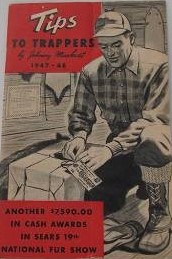
When my dad was a kid, he sold furs to Sears Roebuck. Each fall when animals had developed a full-furred winter coat, he set traplines along fence rows and creeks on his family farm.

The pelts he sent to Sears was graded by experts, with extra bonuses paid for top-notch furs. So when Sears offered a Tips to Trappers magazine, my dad signed up, hoping to increase his earnings. In its pages, he read articles by “Johnny Muskrat” about the best ways to trap animals and prepare pelts.

One tip from Johnny Muskrat changed my dad’s trapping practice.

The further north, the better the furs, Johnny Muskrat wrote.

My dad realized he hadn’t been considering geography. He had been setting traps all over his family farm, paying no attention as to whether he was setting them to the north or south or east or west.

But he believed Johnny Muskrat. So he moved his traps to north-line fences, hoping to increase the quality of his catches. And it might have worked. In 1941, when he was eight years old, he sold a possum pelt for 25 cents.

“That was a lot of money back then,” he says. “Worth nearly $5 today.”

My dad likes to tell this childhood story on himself. He uses the story to help people understand perspective. When he read what Johnny Muskrat wrote about the north, my dad’s world hadn’t yet widened enough to know about places where furs grew thick against temperatures low enough to shatter trees. His thoughts on trapping fell in the bounds of his small world on a mountain farm in western Maryland.

Look beyond—this is what my dad’s story teaches.

Ninety-four Years . . . and Writing

I just bought my mom’s ninety-fourth-birthday gift. And she told me exactly what she wanted.

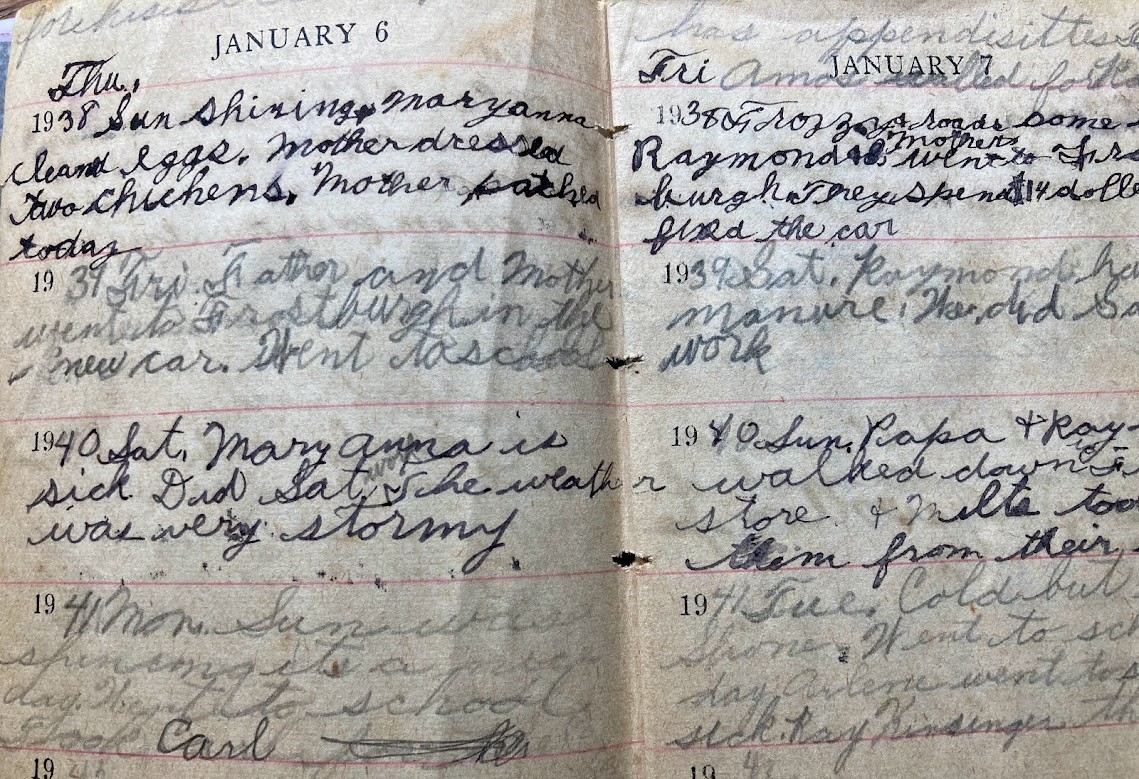
She has been looking forward to this gift for the last five years, ever since she came to me with a problem. The four-by-five-inch diaries she had been using for 84 years, the ones with room enough for only a snapshot of the day, were too small for her failing eyes and too cramped for her arthritic hands.

And, besides, she had explained, her life had become too full to be captured in the one inch of space allowed.

“But I don’t want a one-year diary,” she said. “I want to be able to look back and remember.”

So I found a five-year diary almost twice the size, one that lay flat when opened. And now, five years later, she has filled that diary—all but the last months remaining in this year.

“You said you’d buy me another one if I filled this one,” she said yesterday. “And my birthday is coming.”

So I ordered a diary that could take her to her 99th year.

“Are you keeping a diary?”—this is a question she likes to asks me. And my sisters and brothers. She asks her grandchildren and her great-grandchildren.

Mostly we hang our heads and say no.

But some of us try. A great-grandson posts on Instagram. A granddaughter keeps a bullet journal. I’m making a record of this year with a Second-a-Day video.

“Good,” my mom says.

But there’s a hesitation there. These modern diaries don’t quite seem to count.

And when I see all her diaries in one place, when I pick them up and leaf through the pages written in the early years with pencil and fountain ink and later with a ball-point pen, and when I know that in the next drawer down are decades of her mother’s diaries, I get her point.

Mostly my mom’s diaries address the everyday, the quotidian. They’re about canning peaches and milking cows and ironing and doing field work. And they’re about who has a fever and pneumonia and the stomach flu and scarlet fever and polio. They’re about who dies.

The diaries tell about ordinary days on a farm in the mountains of Pennsylvania during the Depression and World War II. My mother writes of becoming a mother and our family’s big move in the sixties to the gritty auto city of Flint, Michigan. She keeps writing as her children grow and their children are born and their children. And she records the deaths of her brothers and of sister after sister.

I hold her diaries in my hands and watch her writing turn from a girlish scrawl to fine penmanship and finally to a shakier script. And I’m almost convinced to keep a diary.

But not quite.

Come See My View

When I walked past the open door, she stood inside, her arms loaded with damp towels and unlaundered sheets. I felt a pang. I was headed out to explore San Francisco with my husband and grandsons. And she would spend her day in the hotel, cleaning up after us and other vacationers.

Just before I pushed the elevator button, I heard a voice behind me.

“Ma’am?”

I turned, and she stood back the hallway, her arms now free of towels and sheets. Before she spoke again, she searched my face.

“Ma’am,” she said. “Come see my view.”

And in case I didn’t understand her accent, she beckoned me into the room and over to the window.

“Look,” she said, “what I see every day.

And from that window, she gave me a tour of the city.

We marveled together over the Golden Gate Bridge, shrouded in fog, and the hills that define the city and Alcatraz Island squatting in the bay and pelicans flying over the water. Her voice took a tone of reverence.

“See there,” she said, “the Palace of Fine Arts.”

Squinting I could see a domed rotunda with golden colonnades. And I decided to convince my grandsons to visit this taste of Rome. She pointed toward Coit Tower, stretching straight and tall into the clouds. And we looked together at the blue-tinged mountains beyond the bay.

“My view every day,” she said, as she turned back to the towels and sheets. “Thank you for looking with me.”

But my thanks was to her. All day this conversation followed me. I didn’t forget it the next day, or the next. This is a conversation I’ll carry with me, hoping to remember especially when I need to widen my view.

Starting the School Year Strong

It’s the time of year when leaves are tinging brown and young teachers come to talk.

“Last year was a disaster,” a second-year teacher said last week. “What will happen this year?”

“I’ve never taught before,” another said. “How do I start?”

I remember that stomach-clenching end to summer—the dreams about teaching in a nightgown or with toilet paper trailing from my shoe. And worse, trying to get attention as spit wads fly and fistfights brew.

So, I tell these beginning teachers what I wish I had known in my first years of teaching.

“Your most important work in these weeks before school starts,” I tell them, “is to orchestrate the first minutes of the first class of the first day.”

It’s in those first minutes, after all, that students decide if they like a teacher, respect a teacher, and want to learn from a teacher.

“How do I do this?” these young teachers ask.

To that first class, I tell them, bring four things:

  • Ambiance—If a classroom looks and feel like every other classroom, there’s less reason to enter. So offer a classroom with a distinctive sense of place. I played classical music, dimmed lights, and showed videos of crackling fire or gentle rain on the classroom screen.
  • Wonder—In those first minutes of class, forget the rules. Rather, get dramatic with the hellish tattooing of the heart in Edgar Allan Poe’s short story. Or dip a banana in liquid nitrogen and smash it to pieces, like glass, on the floor. Or recite pi to the hundredth decimal while students check your accuracy. Or tell the story of the last soldier who died in World War I, and why his death was futile.
  • Empathy—Show yourself as on their sides. “When I was a student,” you might say. “I hated history. I saw no use in memorizing dates and capitals. So, guess what! That’s not how I teach history.”
  • Order—Make it hard to be bad. Not by reciting rules with an evil eye, but by creating structures for a smooth start. I taped cards with student names to desks—hoping to separate students who might have drawn each other away from learning. And on those desks I placed the first, ten-minute assignment—a writing exercise, one easy to understand and one that would feed into the middle-school proclivity to find how they fit into the world, something like Write about a time you were mad, really mad. Or What do you think is unfair in this world? Write about it. This gave me time to check roll—not aloud since you never know what students might say in answer to their names—but with the seating chart I had already created.

In the first minute of class, students are already asking, Who will make things happen in this classroom?

And you want to be the answer to that question.

Something Rotten in the State of Denmark

The evening was beautiful, but the killing didn’t stop, not for hours. Under stars that hung low and a moon that rose white and silent over the park, people kept dying—by stabbings and poisonings and drownings and execution. By the end of the play, nine of eleven main characters in Hamlet had died, one perhaps at her own hands and the rest at the hands of brothers and lovers and in-laws and erstwhile friends.

Something, for sure, was rotten in the state of Denmark.

My husband shifted in his lawn chair.

“The more they kill, the easier it gets,” he whispered to me.

But I didn’t answer; the last act was beginning.

In a cemetery, Hamlet and Horatio happen upon a jovial gravedigger.

“Has this fellow no feeling of his business,” Hamlet asks about the gravedigger, “that he sings at grave-making?”

Horatio answers: “Custom hath made it in him a property of easiness.”

The gravedigger may be easy, but Hamlet isn’t. Especially when the gravedigger uncovers a skull and tells him it belonged to Yorick, the court jester.

“Alas, poor Yorick!” Hamlet says. “I knew him.”

Hamlet mourns that Yorick’s lips are rotted away. And with them have gone Yorick’s jokes and pranks and songs.

And Hamlet, who has been surrounded by death, suddenly feels sickened. He sees the loss death brings.

I confess that I missed a few scenes after that, thinking about students I have known, who are no longer with us, dying at their own or someone else’s hands. Students who once joked and pranked and are now silenced, by death or by despair.

Sitting there with the stage lights up and the moon and stars shining down, I wished I could redo times I taught with a “property of easiness,” accepting sad and defiant looks as the middle school way rather than as a plea for help.

She Kept Showing Up

She didn’t come to the reunion. Even though we had gathered from across the Midwest and New England and Nicaragua and Hawaii, my ninety-eight-year-old mother-in-law stayed in her hospital bed, breathing along with her oxygen machine and dozing off when her eyes felt heavy. It was the first time ever that she didn’t make it to a Swartz gathering.

Except that she kept showing up.

Saturday morning, we rotated through mini workshops, learning from each other how to decorate cookies, how to manage finances, how to add Latin flavors to everyday foods, and how to garden with native plants.

“Grandma would have loved this,” we said to each other.

While Uncle Tim led a workshop on how to cut your trash in half, I thought of how Grandma had recycled and repurposed long before today’s trend.

And when the family branch from Hawaii taught us how to make Polynesian flower crowns, someone said, “I’m making mine for Grandma.”

For a couple hours at a time, a few of us would go missing. Our names were on the time slot to visit Grandma. And when we showed back up at the reunion, it was often with tears in our eyes and smiles on our faces.

“She’s hanging on to her life, asking about mine,” someone said.

We ended the reunion talking about Grandma—how her definition of family extends beyond us. All of us having been born or adopted into her family might be in the inner circle. But we aren’t the only circle. She is a mother to us, but she has also been a mother to inmates in prison and a lonely neighbor down the street and folks in a homeless shelter.

And acknowledging this about Grandma’s life, makes us think about how we live.

From her hospital bed, Grandma keeps showing up.

A Fetal Position and Claude Debussy

This week a lecture on music helped me understand Charlie.

“Don’t talk to me,” he said, as he came in my classroom door. “I just want to be here.”

And he curled in a fetal position on an oversized ottoman in the far corner of the classroom. The next day in the quiet, after-school hour, I heard the door creak again. This time, Charlie didn’t say a word, just stopped my words with a gesture. He stayed on the ottoman twenty minutes before he walked out . . . without a word, like he was evaporating into thin air. Again and again Charlie did this, until the end of the year.

He was cared for, I knew, by his parents and a counselor. And he participated in gifted class, right along with the other students. But I knew from his writing that he was angsty, that what he knew about the world was too heavy for him to bear.

So keeping silent while his nearly man-sized body curled in a fetal position on the ottoman felt impossible to me. But with sheer grit, I managed to hold my words. I somehow sensed I should follow Charlie’s cues.

The music lecture I heard this week showed me what Charlie asked of me back then—to quit being like German composers, Brahms, for example, who march people right along with harmonic progression and resolve every dissonant chord.

Be less like Brahms and more like the French Debussy, Charlie was telling me. Debussy’s music doesn’t have a steady forward beat. Dubussy’s music stays put in an almost stationary environment, soaking up the color and hanging with the dissonance. With Debussy, the lecturer said, music simply evaporates. It doesn’t end. There’s no need to resolve.

When Debussy wrote his music, he was breaking with the move-right-along harmonics that had been working since the Renaissance. And when I kept silent with Charlie, I was breaking with all my teacherly instincts to propel Charlie into next steps.

“With Debussy,” the lecturer said, “you have to listen differently. If you try to listen to Debussy the same way you listen to Brahms, you won’t appreciate the music.”

I have a regret about those afternoons with Charlie. Though I was silent with my mouth, I wish I had managed an inner stillness. I hope my anxiety didn’t float across the room toward that ottoman.