Party and Torture

At Trachselwald Castle, we found a party. Accordion music, a chocolate fountain with fruit to dip, and a market in the castle square where vendors sold cheeses, handcrafted wares, and wine.  

If I hadn’t known what was in the tower above, all this levity would have seemed like a fairy tale, like what I’d imagined I’d enjoy in Europe. But the tower was up there, and we climbed up and up and up, circling on narrow stone steps, sometimes almost as steep as a ladder.

When we arrived at the top, the mood changed. Steps slowed, voices muted, and faces became guarded. We shivered in the dark, cold stone cells. And I tried to imagine being held prisoner, lying on the hard wooden bed while I wondered if morning would bring torture or death or both.

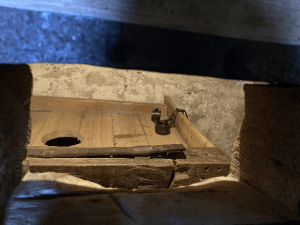
Across the hall was the torture chamber. Sobered by the ball and chain and a device to swing prisoners in circles, I was most gripped with the hole in on the torture shelf. It was needed for bowels that loosened during twisting tortures. I stood silent, my own insides churning with these thoughts.

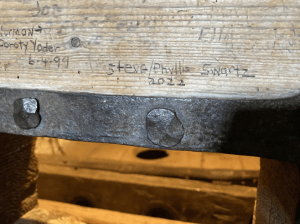
In the hall outside the torture chamber were signatures of other Anabaptists who had come to pay honor to those who suffered here for faith. We found the names of people we knew. And we added our names.

But then I noticed other signatures. . These had been carved into stone, not pressed easily into wood with a pen. These signatures took what prisoners had—time.

We wound back down the steep stone steps, back down to the accordion music and chocolate and cheese and wine.

And as we left the castle, I thought about how often I have partied while others mourn.

My Family’s Version of the Hiding Place

“I keep seeing grey-haired women and thinking they’re you,” my son said.

We were in Guggisberg, Switzerland, where we had happened upon a festival. The town was celebrating its 1000th birthday.

I knew what he meant. The cheese maker stoking a wooden fire looked like my cousin. The straight-backed and full-throated people singing Swiss folk songs around a table could have been my aunts and uncles. Two women walked toward us on a path.

“They’ve got to be Brennemans,” I said to my husband.

We drove through the countryside to the Swartzentruber farm. Here my ancestors cultured milk over small fires and pulled the newly-forming cheese into cheesecloth so it could be pressed into molds. Here they cut the meadow grass with scythes, dried it in the sun, and raked it up to store in barns as winter feed for their cows. Here they kept an ear toward the ringing of the cow bells, as their livestock grazed sometimes out of view in the hilly landscape.

I stood still and listened. And from across the meadows flowered by mountain cowslip and heathers and buttercups, came the melodic sounds of cowbells, still chiming 500-some years later. What peace, I thought.

Except that in the barn just up the lane was our family’s version of the hiding place. In the barn that sheltered cows during harsh winters when deep snow covered the pastures from November to April and avalanched down the mountain, was a secret room. And in that room my family hid when they were hunted.

Anabaptists, my family had broken from the state reformed church. So that church and the government of Bern threatened them with expulsion, imprisonment, torture, and death. But sympathetic neighbors lower on the mountain signaled a secret code when Anabaptist hunters came riding. That’s when my family quit turning meadow grasses and pressing cheese, and disappeared through an inconspicuous trap door into the concealed room on the lowest level of the barn.

These were my people, I thought as cowbells chimed and meadow flowers swayed—in such a peaceful place with such danger looming.

Back at the festival in Guggisberg, I bought a cowbell. I’m going to hang it in my house . . . and remember.

A Cascade of Unfortunate Travel Events

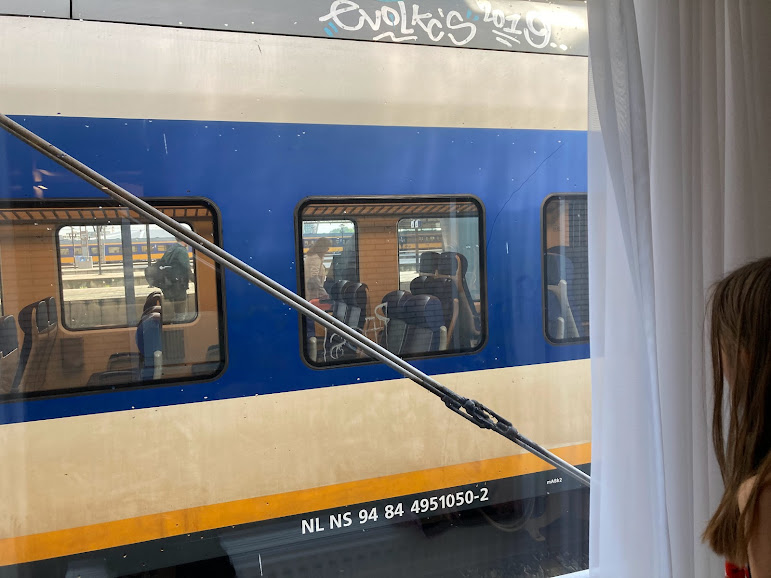
Our bumbling—my husband’s and mine—set off a cascade of unfortunate travel events. And as a result, our three-generation family group was separated, finding ourselves in three locations: two in a train headed for Switzerland, one in the Milan train station, and five in a train headed for Milan.

What happened?

All set to board a train, Steve and I remembered we had forgotten to activate our Eurail passes. Since we had ordered old-time paper passes, we had to go to a ticket center with a long line. And our son, likely doubting our capabilities (though he was much too gracious to say so), came to help . . . and we’ll spare you the details from there.

All that day, we wondered when we’d get together again. And if we’d miss riding the Glacier Express through the Alps. All that day we searched for new routes on phones losing their charges, wishing our chargers and our computers and everything else we needed hadn’t been left behind to burden those already managing their own luggage.

That evening when Steve and I watched the last train pull into St. Moritz, we didn’t know if our kids and grandkids were on that train. But they were.

Today, God willing, we plan to ride through the Alps. And together!

People sometimes think it’s brave to travel with kids. But obviously seniors—who do well when they remember they forgot—are the greater liability.

Leavin’ on a Jet Plane

When a plane flew overhead, it marked our day. My brothers and I lived, after all, in the mountains, a hundred miles from the nearest airport, and in a time when many still traveled by rail. So when we spotted a plane, we’d stop naming the clouds, no longer caring one was a ship sailing across the sky and another a face staring down at us—three kids in our yard. We’d watch the plane’s tracks fade into blue and wonder how someone could get lucky enough to fly.

Until I was forty-years old I didn’t. My first flight at the roundtrip cost of $38, was one hour long—from Columbus, Ohio, to Chicago, Illinois. But in that hour, I knew I had been right as a kid. To fly is to be fortunate.

And I haven’t lost the marvel. In the many times I’ve flown since, I want to elbow the people around me—the ones who close their eyes and plug their ears and pull down the shades.

“Look down,” I want to say. “And you’ll see how the world fits together—the checkerboard fields and rivers running down mountains and across the land and into the ocean. From up here, you can look down on clouds.”

I sometimes wonder if there are still wide-eyed kids down there staring up from their yards, hoping a plane will streak across the sky.

In a few minutes, I’ll board a plane. We’re meeting our son and his family in Rome and traveling with them through Switzerland and Germany and the Netherlands. We’re going to see the sights—ride the Glacier Express through the alps, boat through canals, visit art museums, and hike in the Black Forest. We’re also going to trace church history—explore how the reformers broke from the Catholics and how the Anabaptists (including our forebears) broke from the reformers.

We’ll walk through the villages and farms where our long-ago family lived and visit places they hid before they fled from persecution, first in Switzerland and then in Germany. Finally, we’ll tour Rotterdam, the port city in the Netherlands, where they boarded ships to journey to America.

For months we’ve been planning this Rome to Rotterdam trip.

But right now, I’m going to board a plane and be amazed. A 400-hundred-ton metal cylinder, carrying a cabin-load of passengers and all their stuff, will lift off from the ground and soar across the sky.

My Last Lecture; My Last Call To Do Good in the World

After teaching thousands of classes, today I taught my last. At least in a formal sort of way.

Seven years ago, I retired from full-time teaching, but since then I’ve been teaching education classes as an adjunct. Today, I gave my last lecture, led my last student exercise, and issued my last call to do good in the world.

And I received my last teacher gift. Apples, fragrance, candles, pens, paintings, clocks, pads of paper, and packs of pencils—all these gifts and more have filled my desk for decades on the last days of school. Some of these gifts are still scattered around my house.

Today’s gift symbolizes for me what I hope I’ve done at least a few times in my thirty-seven years of teaching. It’s a book, handmade by a student.

And on its cover, my student painted her interpretation of a poem. In “Root Cellar” by Roethke, feisty plants refuse to give up life in a damp, dark cellar filled with mold and manure. In this cellar, Roethke says, even the dirt keeps breathing a small breath.

But my student didn’t stop with Roethke’s imagery. In her dark and gloomy painting, she hung lightbulbs.

“Thanks for giving me hope,” she said when she handed me the book she created.

What she can’t realize is how much hope she and her classmates have given me.

Today I spent a moment of class, just looking at faces.

My grandchildren, I thought, would be in good hands with them.

Something Old for My Birthday

For my birthday this year, my parents gave me something old. And something I’ve long hoped to own. Not because it has monetary value, but because of a magical moment I spent in front of it some sixty-four years ago. Three years old, I had been sitting on a bench in front of it—a small children’s bookcase in our living room in Grantsville, Maryland. My parents had read the books on its shelves so often to me that I had memorized parts of them.

That morning for some reason, a few of those words popped out to me. Unexpectedly, I knew them. And they were on other pages. I tugged on my mom’s skirt as she changed my brother’s diaper.

“Look!” I said. “I know this word. It says ‘jump.’ I’m reading.”

I wanted to know every word in the world. All that day, I followed my mom from the kitchen sink to the ironing board to the rocking chair, always tugging on her skirt.

“What’s this word?” I’d ask her. “Is this word ‘laughed’?”

I can read, I told myself that night in bed.

The next morning before I opened my eyes. I thought something good had happened. And then I remembered—I could read.

I’m not sure where to put this little old bookshelf. In our living room? In my writing room? In a bedroom? And will I fill it again with children’s books? Or poetry? Or my Pearl S. Buck collection? Whichever room and whatever it holds, I’m glad to have it where I can see it often and remember the day when words began popping from pages to widen my world.

Circle of Life

They call him Dr. Miller, so he’s got to be smart. But my nephew Jonathan doesn’t know the history that’s practically under his feet. And I didn’t know either. Not until a recent road trip my dad and I made back to western Maryland so he could pay respects at a funeral.

“Want to see Jonathan’s office?” my dad asked, and he directed me to drive to the last street at the very edge of the town.

We sat in the car, my dad and I, in the parking lot of the medical center where my nephew hangs his shingle.

Inside that office, Jonathan takes medical histories and orders diagnostic tests. He reviews labs and x-rays and writes treatment plans. And he teaches patients about healthy lifestyle choices and disease prevention and helps people take control of their health.

My dad sat silent. He watched the people coming and going from his grandson’s office. Then he turned his head to look over the fields that had come out to meet the town. Finally, he stirred.

“Know what I remember about these fields?” he asked.

And he told me how he’d driven sows across those fields from his father’s farm to the Hershberger farm to get them bred or slaughtered, according to the need.

“Look up through those trees,” he said. “See that barn up the slope? That’s where I took them.”

I tried to picture my dad, a barefoot farm boy in coveralls, who had never dreamed he’d move from the mountains of Maryland. And who decades later never dared to hope that one of his grandchildren might find a partner in back in those mountains and settle there.

This was a circle-of-life moment for my dad, sitting there with the fields of his childhood on one side and the medical office of his grandson on the other.

At the next family reunion, I hope my dad gathers Jonathan’s five children, who now run barefoot in the mountains. I hope he tells them about how he once drove sows to slaughter just outside their father’s office. And I hope that after Jonathan hears this story, he occasionally looks toward the fields as he leaves work at the end of a long day and thinks of the people who toiled there before he was born.

My Cousin Beat Me To It

She got what I had wanted—my younger cousin—a little house on a patch of ground at the curve of the creek near the edge of the lawn of my childhood home.

“When we move in, come visit,” she said. “We’re as close as anyone can get to that bit of land you tried to buy when you were a kid.”

My cousin was referring to a story I tell in my memoir Yoder School. Eight years old and about to move from the mountains of Western Maryland to live in Flint, Michigan, I cast about for a way to find some comfort. And walking up the lane one day after school, I found it. The lane, the creek, and a row of trees formed a triangle around a parcel of land maybe twice as big as my bedroom.

I’ll buy this land, I thought. The land would wait for me while I was gone. And later, after I became a teacher, I’d come back and build a small house on this land and teach at Yoder School.

I sat under the maple tree and looked around. Along the creek, shepherd’s purse plants waved in the breeze. Bees flitted in the daisies.

The land belonged to Luella and Meely, two ancient sisters with silver hair who wore ruffled aprons over their plain dresses and bustled around every Wednesday baking cinnamon rolls. They sold these cinnamon rolls for spending money.

If I bought this plot of land, I thought, they’d have even more spending money.

In my bedroom I climbed on my desk to get my piggy bank from the high shelf. The pink pig with a big belly, a red hat, and blue coveralls sat on its hind legs staring out of big black eyes. I’d be willing to give up my entire savings for the land, I decided. My ancestors had lived in these mountains for over a hundred years, and I belonged here, too.

I held the pig in one hand and knocked on Luella’s and Meely’s door with the other. This was Wednesday, and I could smell the cinnamon.

“Come in!” Meely said.

And then I didn’t know how to start. So I stammered around explaining that I needed to own some land and I wanted it to be near my house and the triangle between the creek and the lane and the trees would work fine and I was prepared to give them all the money in my bank for the land.

Meely looked at Luella. Luella set the spatula beside the cinnamon rolls she had been frosting. She squatted down beside me and explained that, no, they didn’t want to sell their land, not even this little part of it, not even for all the money in my piggy bank—not even if I saved for another year.

I swallowed and blinked so I wouldn’t cry and said that, no, I didn’t want a cinnamon roll. And I fled.

This last week, sixty years later, I drove along the curving creek and saw the land I tried to buy. And sure enough, there was my cousin’s small house nestled into the rise of the earth at the outer edge of a retirement village.

I’m looking forward to drinking tea in that little house. And I hope she doesn’t forget to invite me.

Don’t Look Like You’re Lost

My uncle had one piece of advice for his country relatives when we visited New York City—When you go somewhere and you’re lost, don’t look like you’re lost.

As he stood on the city street in pointing us toward the subway, doubt would flicker across his face. And he’d wonder aloud if he should have taken a day off work to show us around.

But he hadn’t. So while he supervised students in an electronic microscope lab at New York University, we’d bumbled our way through a few of the 80 some museums in the city and explore Central Park, our walk never quite brisk enough and our colorful t-shirts too tawdry in the sea of cosmopolitan black.

But we kept going. And when we missed a subway stop and couldn’t find 5th Avenue and couldn’t remember which way was north, we tried to act confident when we weren’t.

A couple years later, I used my uncle’s advice again. Just before walking into class on my first-ever day of teaching, it hit me—I don’t know how to teach. What if no one listened to me? What if a fight broke out? What if my course requirements were too hard? Too easy? What if I opened my mouth and nothing came out?

I wanted to walk out the school door and go home and wrap up in a quilt. But I had to go in there. Students were waiting.

“Don’t look like you’re lost,” my uncle had said.

So I breathed in deeply. And out. I lifted my chin and squared my shoulders. I picked up my books and cleared my throat. I made my steps brisk and walked through the door.

And I taught my first of thousands of classes.

I’m glad we ventured into New York City, even though we bumbled our way through. And even though I bungled lots of classes, I’m glad I walked into that first class on the first day of my first year of teaching.