Funerals are for Finding Old Friends

“I saw you during the funeral, and I’ve been looking for you,” a long-ago school chum from Yoder School said this week. And he dropped into the empty seat beside me at the after-funeral meal.

It was Wayne Beitzel, the funniest guy in my second-grade class, the guy who always had a story.

“You won’t believe what happened,” he said.

With Wayne, something always happened. He made sure.

Take, for example, the time surveyors came to mark the route of the new Interstate 68, which would bisect his family farm. Early one morning he and his kid brothers set up a lemonade stand right in the surveyors’ path.

The surveyors took this in good humor, buying all the lemonade before asking the boys to move their stand. Eminent domain, after all, includes compensation when property is seized. The Beitzel boys didn’t let such opportunity pass them by. The next day, surveyors came back to the Beitzel farm to find the lemonade stand back up, just further down the path. And the day after that.

These daily lemonade sales were making the Beitzel boys a fortune. But the path of poles and flags were reaching the edge of the farm. So one evening, the boys found a way to prolong sales. They complicated the next day’s work by moving poles and flags.

“That’s why there’s still a curve in Route 68,” they like to tell people.

This was a story from long ago, but Wayne had a new story.

“The other day,” he said. “I was browsing for books on Amazon, and I saw Yoder School.”

Was this his Yoder School, he wondered, and clicked on the link.

“When the book came,” Wayne said, “I opened it to a random page. And the first words I saw were Wayne Beitzel was a Mennonite, and his dad owned the Springs Store.

Wayne and I chuckled over this 58-year-old memory—how Amish Lizzie thought Wayne was lucky because in his packed lunch were fancy cookies from his dad’s store but how Wayne thought Lizzie was lucky with her wonderful homemade cookies. But they found a way to both feel lucky, trading cookies each day at lunch.

It was fun, sitting there over funeral food with Wayne Beitzel. Funerals, I’ve found as I’m getting older, are for mourning. But funeral feasts are for finding old friends.

My 89-Year-Old Father Gets Himself a Bedside Manner

I’ve got something to say about my 89-year-old father.

This is the father who spent decades writing organizational policy and writing sermons, who reads and writes history for pleasure and because history matters, who would rather sit in a committee meeting with goals to reach than go to a party, where it’s hard to know what to say.

This is the father who brought me up to do deskwork—to balance household ledgers and pay bills and type letters from his dictation. He oriented me to his elaborately subdivided four-drawer subject file. He taught me to scan articles in periodicals to determine their foci. And if it was an article, for example, about what amillennialists believed about the Great Tribulation, to file it under ES-AM-GT. This is the father whose idea of having fun with me was to help me trace my ancestry to the other side of the ocean.

This is also the father who has been known to faint at the sights of needles and blood and who avoided diaper changes when he could and gagged through them when he couldn’t. Although I’ve heard lots of people say nice things about my dad, I’ve never once heard anyone rave about his bedside manner or say he is a natural caregiver.

But these people haven’t seen my dad lately.

My mom’s been through some tough times—a series of falls and fevers and digestive disturbances.

When I checked in by phone this morning, her voice broke.

“Your dad has been so good to me,” she said. “I feel sorry for what he’s had to clean up after me.”

“You should have called me,” I told my dad.

But he had another view.

“Sixty-eight years ago,” he said, “I made a promise that I intend to keep.”

I’ve long admired my policy-writing dad. But never as much as I do now when I watch him count pills and fix sitz baths and tuck my mom safely into bed.

It’s only then that he goes back to his study to write some more history.

Someone Else’s Grandkids

We took our grandkids to prison today. And this right after they visited their saintly 98-year-old great-grandma. We thought the contrast would provide an interesting day. And besides, the old Ohio State Reformatory was on our way home.

The kids were incredulous when we drove up to the reformatory.

“This looks like a castle,” one of them said.

And from the outside, it did. The architect used three styles—Victorian Gothic, Romanesque and Queen Anne—to inspire inmates, to help them become ready to re-enter society. But once inside, life was anything but uplifting.

The prison, built to hold 1,500 people became quickly overcrowded and notorious for poor conditions. Kitchens were overrun with rats and their droppings visible in food. Punishment involved water hoses, sweatboxes (for non-white inmates), electroshock, and confinement in a hole in the ground.

A federal court finally closed the prison because of inhumane conditions, but not before the deadliest prison fire in United States history broke out. As smoke filled a block of 600 cells stacked six tiers high, inmates begged to be let out. But most guards refused to unlock doors. When the roof collapsed on the upper level of cells, 160 inmates burned to death. And by the time the fire was under control, 320 people had died and another 130 were seriously injured.

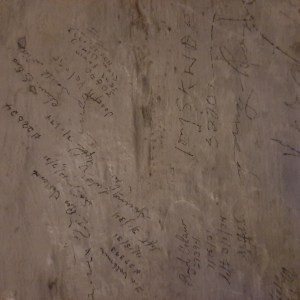
I had learned these stories while teaching at a state prison decades ago. But I had never seen what touched me most on this tour—the writing on basement walls, where overcrowding had turned storage areas into dormitories.

“Use the flashlight on your cell phones,” our tour leader said. “And find the writing on the walls.”

Two of my grandsons, both of them towering over me, one of them the age of the youngest inmates I had taught, joined me in reading name after name. Important dates were listed under some names and inmate numbers under others. Under still others were numbers counting the years since sentencings.

“I’m here,” these markings seemed to say. “I’m a person. I matter.”

Standing In that dim dungeon of a room with my grown-tall grandsons, I caught a new sight of those young inmates I had taught so long ago. They were someone’s grandchildren, someone’s great-grandchildren. If I could teach them again, I’d try to keep this firmly in mind.

In the Company of Clocks

“You know what I remember most about you?” a former student asked me yesterday as she checked out my book at the library.

I was hoping for something like you taught me to love learning.

“Your clocks,” she said, “especially that melting one.”

When I retired, I brought home my classroom clocks—the Salvador Dali melting clock, for example, and the counterclockwise clock and the math-quiz clock.

And these clocks merged with my home collection—the light-up word clock and the days-of-the-week clock and the binary-time clock and the moonlight clock and the marble-rolling clock. And I could go on. Just ask my husband, who heroically made his rounds last weekend in what is hopefully one of the last time changes.

I like the company of clocks. I like the chiming and donging and whirring and how clocks steadfastly tick away the time. There’s something about their circling hands that mimics the sun rising and setting and the stars swinging slowly across the sky and the moon being born and dying and returning to life again. This going around and around brings the night and the day. It ends the months and the years and the decades.

You can’t touch time or smell it or see it. Not really. It’s an abstract idea. But clocks make the concept of time visible. And some clocks show this in fascinating ways.

I liked to watch students consider my clocks. When they stood in front of Salvador Dali’s melting clock, I hoped they would think about how time can feel distorted—how a minute on a dentist’s chair feels eternal while an afternoon skateboarding passes in a flash.

I hoped my counterclockwise clock made them curious about how the movement from left to right became standard for clocks, how many things became standard.

Now that I’m retired, all these clocks under one roof keep me strangely alert, as if messages are afloat in the air. And they keep me wondering—what if . . .

Come to think of it. Getting remembered for clocks? This is fine with me.

A Tribute to Martha Stoltzfus

Last week, my friend died.

Martha Stolztfus was a character. To me, at least, she felt like a person you could lift from life and set in a book and people would want to read it. Or maybe it was the other way around—she stepped out of a book to become a real-life character.

With Martha, I kept seeing different sides and wanting to know more. The demure side, for example. She was a great-grandma, after all, and a preacher’s wife. Sitting in a church pew with her hair tucked neatly under her prayer cap, a Bible in her hands, and her face carefully composed, she was the model of piety.

But she also had a tongue with some spice, spice that flavored up a conversation and made it something to remember. Once at a writers’ retreat, she took on a bunch of young’uns, as she called us since we were all a generation or more below her. We were sitting around coffee, using big words to talk about abstract concepts.

Martha, who probably had a greater readership than any of the rest of us, hadn’t said a word, just kept moving her eyes from one speaker to the next.

“What do you think, Martha?” someone asked.

“Only this,” she said, “that if you all knew what you were talking about, you could say it plain out.”

And she had us there.

Seeing Martha, as quick and light and diminutive as the birds she fed outside her window, you might not guess that she had forded rivers and waddled across a swinging bridge on her way to give birth, that she had fought coal soot and mud and copperheads, once taking a .22 rifle after a snake in her martin box.

Martha crossed cultures, leaving Pennsylvania’s Amish country to live in an Appalachian hollow, a deep chasm with high, close-in hills. She learned to love this hollow, where the sun shone late and left early, where each spring, she counted off the cold snaps—Redbud Winter, Dogwood Winter, and then Blackberry Winter, one after the other as they first dotted the dark, bare hills with their blooms and then turned impish, and blasted them with polar air.

Impish, that was Martha. Anyone could see her sincere faith, but running through it was a saucy sense of humor that kept me curious. What would she say next?

The Marvelous Pencil

When I was a kid, I’d turn a brand-new, freshly-sharpened pencil in my hand.

Inside this pencil, I’d think, are words, waiting to come out. All I have to do is put its tip to the paper and see what happens.

So I’d turn on my imagination and listen to the scratchy sound of lead as it left a trail. And if I messed up, there was the eraser on the other end, ready to forgive so I could try again.

These days I write with a keyboard . . . mostly.

But the other day, my computer couldn’t clear my muddled thoughts. So I went in search of a pencil. I found a dozen. But they had dull leads and worn-down erasers, and chewed-on sides.

After the pencil sharpener ate up my few remaining hopefuls, I lost patience. And just yesterday a box of 150 pre-sharpened, number 2 pencils arrived on my porch.

I’m counting on these pencils to help me think my way out of my muddle. Studies have shown, after all, that writing by hand lights up the brain. Handwriting is more tactile than fingertips on a keyboard. And its sensory nature calls on various parts of the brain to work together to fire neurons and open the brain.

Handwriting slows the thinking process, helping students go deeper and wider. And because writing by hand uses more brain power than keyboarding, students understand more and remember longer.

And besides, pencils are fun. They smell like the first day of first grade. They connect you to trees and to earth-mined graphite. Pencils have been in the hands of John Steinbeck, who is known to have used as many as 60 a day to write his novels and in the hands of American and Russian astronauts, who take them on space missions since pencils work in zero gravity.

So the next time you pick up a brand-new pencil, turn it in your hand and marvel for a moment. The pencil you are holding can draw a line 35 miles long and write about 45,000 words.

Scary Students; Scared Teacher

If I could subtract one thing from my career, I’d choose fear. I was a scared teacher way too often. Especially when it came to firsts—the first class of eighth graders and of highly gifted students and of minimum-security inmates and medium-security inmates and even death-row inmates. The first college class I taught and the first parent-education group. The first time we had a murder in our hometown and the sons of the murdered and of the murderer were both in my homeroom.

How, I often wondered, did I keep finding myself in these daunting places when my threshold for fear is low? I don’t ride roller coasters or see scary movies or even eat spicy foods. And I can’t understand why people seek these thrills.

A pounding heart, sweating palms, and shaking knees—I do what I can to avoid all these.

Except, apparently, when it comes to teaching.

Perhaps I kept going back for more because I came to see that, though I usually started out with dread and shrinking, I didn’t have to stay there. I learned by necessity that I could move my focus off my anxious self and settle it solidly and gently on my students.

I’d move in close, passing by their desks, looking into their faces as though I knew I’d find something interesting there. And when you look, I discovered, you find. Even when faces are shuttered.

Those shuttered faces! They threw me at first, But I learned to keep looking, keep expecting. This drove out my fear. And it opened students to me and to learning.

In each new place—the middle school, the prison, the gifted program, the college—this started as an effective strategy, something that worked. But soon came the magic. What had been a form, turned to feeling—something warm that flowed from me to them and often also from them to me.

And this feeling, love or whatever it was, worked better than fear.

Next Best To Amtrak

I’ve been longing for the train. Never has my writing brain worked so well as on a 126-hour, 5000-mile Amtrak trip across the country last fall. Sitting by my husband on a heating pad with a shawl around my shoulders, watching the ever-varied scenery out my seat-to-ceiling window, hearing the rumble of wheels on the tracks, and swaying with the train—all this helped me write better and faster than ever before.

It was like I could feel the neurons firing across the bumps and groves of my brain. The lobes—the frontal and the temporal and the occipital—each did a part, syncing as I plotted and polished. And chapters flowed from my fingers.

But I can’t climb on a train every day.

So when I put my hands to the keys to write a daunting revision this week, I settled for next-best—train cam videos on YouTube. On dozens of channels, millions of viewers a day watch hundreds of trains, some recorded, others in real time.

I joined the millions this week. Sitting in my living room on a leather recliner even more comfortable than a train seat, I clicked away on my computer. One day I wrote as a train lumbered up mountain passes and bored through the tunnels to make its way across Montenegro to the Adriatic Sea.

Another day, when I was stuck on a word, I looked up to see a train screeching to a stop in Elkhart, Indiana. I’ve been across those railroad tracks, I thought. And maybe because I had quit trying, I found the word I needed.

“No hurry,” I told myself one afternoon when I couldn’t get it right. “Slow down, and it will come.”

It was, after all, another nine hours to the Norwegian Arctic Circle.

All week, I took my pick: winter in the Swiss Alps, spring in the Netherlands, summer in New England, and harvest in the U.S. Midwest.

I’d rather be moving with a train than watching one. But with train cam, I can almost forget I’m sitting still and concentrate on writing.

What I Didn’t Know About Alvina

Alvina is the star of my book Yoder School. She taught me in first grade the most important lesson of my education—that learning is magical. And she made this lesson so convincing that a decade later, when I sat in high school chemistry where the wall clock seemed to take a minute to tick a second, I was sure that with different teaching, chemistry could crackle.

When Alvina taught, time melted away. Suddenly, it was lunch, and I had spent the morning messing around, trying to solve a puzzle and find the right word for my journal and make something cool. All morning, my tasks had kept bringing my energy back to me.

As a child I thought Alvina’s joy-filled teaching must have come from a burden-free life.

I didn’t know that Alvina had followed the horse-drawn wagon carrying casket of her little sister to the graveyard. And that not long after, her father had taken ill, becoming so weak he could no longer pick her up, that he died a few weeks before Easter, and that her mother was so distraught, she passed out at the funeral.

I didn’t know that Alvina’s teacher training had been accelerated because of the World War II teacher shortage. Even her trip to college was fraught. The train being filled with soldiers, she stood or sat on her suitcase for nearly twelve hours. Once at college, she took classes at almost twice the normal rate. A case of mumps placed her in such a strict quarantine that she wasn’t allowed to touch books or paper or pencils. So, although her friend sat on a pile of dirt outside her window to read history lessons to her, Alvina couldn’t take notes. And she earned a D in history.

I didn’t know Alvina entered her first year of teaching thinking she had no idea of how to teach, that she was scared but couldn’t tell anyone because, after all, she had been to college. And her first teaching years weren’t easy. When Alvina started teaching at Yoder, it was a one-room school. One year she taught forty-seven students spread across seven grades.

All I knew is that teaching seemed to be a glorious adventure for Alvina. And that I wanted to be a teacher like her.

Not until a couple decades into my teaching did I learn that Alvina’s exemplary teaching didn’t come from a pain-free childhood, an exemplary teacher-training program, or ideal teaching conditions.

Best views, after all, come after hard climbs.