
You can tell you’ve lost them. It’s the far-away look, the doodling pencil, the hand that never raises, or the head on the desk. The signals are clear. They’re begging for a break.
You’d be wise to listen. Breaks, especially those with physical movement, boost brain function. The change of pace increases blood flow, which in turn brings more oxygen to brain cells. And while brains may seem to idle during downtime, they are actually filing information into stored memory. This clears the brain for new learning. These brain breaks, I found, not only increase the academic performance of my students. They also decrease disruptive behavior.
So what are some simple ways to call back wandering minds? You’ll find lots of ideas for brain breaks on the internet, but here are a few of my favorites:
- For college students:
- Enrolling Questions—Ask a series of questions in which students stand for a yes answer and sit for a no. You can ask relational, non-content questions: Have you decided on a major? Do you and your parents and siblings agree on politics? Or you can ask content-based questions: Did you agree with the basic premise of last evening’s assigned reading?
- Class Continuums—Say, for example: After reading the chapter comparing functionalism and conflict theory, what do you think? If you identify closely with functionalism, move to the left side of the room. If you identify closely with conflict theory, move to the right side of the room. Or if you are somewhere between, move to the place in the room that shows your thinking.
- For high school students:
- Timed Talk: Invite students to silently cluster in sections of the room with two or three friends. Signal with a bell for free talk time to begin. At the second bell, students should return immediately to their seats.
- Music: Play loud dynamic music or soft soothing music while students stretch and relax.
- For lower-grade students
- Silent Ball: With students standing, toss a beach ball over their heads. The goal is for students to keep the ball aloft as long as possible—and all without talking. For increased challenge gradually toss in another ball or two.
- Exercise Countdown: Ask students to stand silently by their desks and call out the exercise: 5 jumping jacks, 4 toe touches, 3 knee bends, 2 leg lifts, 1 sit up.
- For active reviews:
- Roving Review—Tape a numbered review question on each desk. Give students a paper numbered to 30. Students move from desk to desk to answer the different questions.
- Racing Review—Have students jog in place by their desks. Ring a bell to stop students. Read a review question to student and have them sit to write their answer answers. Repeat.
Fatigue seems to fade when students move, laugh, and mingle with their friends. After all, they’re now high on dopamine, the happiness hormone, ready once again to learn.
 If I were teaching social studies or literature, I’d bring Lee Ufan to class. I saw his work first at the Columbus Museum of Art, where I lead tours. I walked into the gallery and was instantly captivated by the broad, flat brushstrokes he drags across the otherwise undisturbed chalky white canvases.
 I’d show students another painting, also entitled Dialogue 2018. How, I’d ask, does this painting—with its one continuous brushstroke—show a running conversation inside the head of a character? Or . . . how does the painting show a constantly repeated dialogue within a group of similar people? How does Ufan illustrate that, at the beginning, there is often more than one inner voice? And how does he show that, in the end, an accepted common narrative eventually pours out?
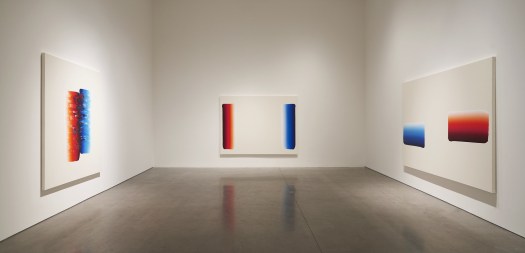 Ufan liked to hang multiple paintings in one gallery—as if the paintings were having conversations with each other. Above you see an installation from the Dialogue series at the Pace Gallery in New York City. Tell me, I’d say to students, about the conversation in this room. How does it relate to the literature you’ve read or to an event in history or to the current times?
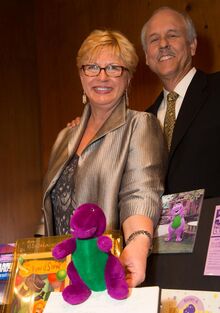 I hadn’t known, but this was the lead I needed. I discovered that Kathy O’Rourke Parker was a co-creator of Barney and Friends. And she had a husband named Philip Parker who was a math teacher and who had, besides, written more than 100 songs for the Barney television series. They lived in Texas.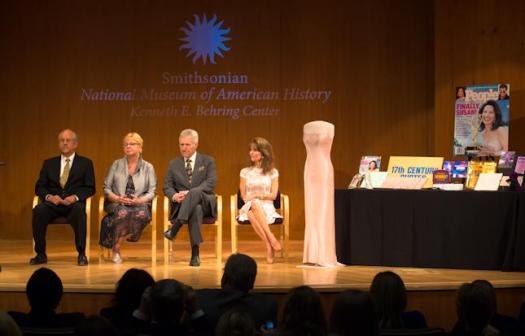

 Apple to Apple