Avoid the Summer Slide

Teachers worry about the summer slide. Students often lose academic muscle in June and July and then need August and September to tone up again. This is why many middle and high school teachers assign summer work, which most students let slide all summer until the week before school starts again.

Perhaps a more effective summer-time approach to academics is to grow readers. Kids who read have advantages. Reading develops imagination and logical thinking. It improves writing, increases knowledge, enlarges understanding, and develops empathy.

Some kids need no help in becoming passionate readers who wonder and question and predict as they read and who make inferences and life connections that go beyond the page. But some kids need help. How can you coach parents to help reluctant readers move into greater engagement with reading? Here are some tips to pass on to parents:

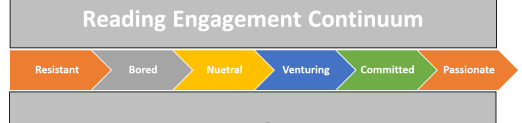
Reading Continuum

  1. Schedule an eye exam. If a kid is resistant to reading it might be because words look fuzzy or letters jump around on the page or lines of text weave. Kids grow and change quickly, and so can their eyes.
  2. Build a reading community. Read what your kids read and then ask them questions—not in the form of a comprehension quiz, but as a real inquiry: I was trying to figure out what I would have said if I had been in that situation. What would you have said?
  3. Capitalize on impoverished environments. In bathrooms and bedrooms and vans and waiting rooms, subtract digital devices and add books. Tell a kid at bedtime: It’s time for your lights to be out, but I suppose if you want, you could read for twenty minutes.
  4. Ritualize reading time. Some schools use a DEAR (Drop Everything and Read) program. At DEAR time, students and all staff, stop right in the middle of the school day and read at the same time. Try this at home. I grew up with reading suppers. Every few weeks my mom would announce one, and we’d all show up at the supper table with a book. Reading, we could tell, was a treat.
  5. Flex with the kid. Don’t insist on a list of classics or on books you would like to read. Follow the interests and learning styles of the reader—books with visuals, books about skateboards, fiction or nonfiction. Tantalize reluctant readers by reading the first few chapters aloud and then handing the book over. And remember that this is leisure reading, not school, so let kids abandon books they don’t like, skip boring parts, and peek at conclusions.

Following these tips can help kids avoid the summer slide and come back to school with minds full of ideas and a sense of themselves as readers.

Congratulations!

I tried again. I sent a query letter to another publishing company. With the query I sent two sample chapters, a table of contents, and a vita.

The next day I found an email in my mailbox. Send the whole manuscript, the publisher said.

A few months later, though, their response was more complicated. They were open to publication—but only with successful revisions.

A memoir can have two narrative voices, I learned—the experiencing narrator and the remembering one. I had told my story as the experiencing narrator. I had written about my experiences in second grade at Yoder School and at Bendle High in the Flint public schools. What was missing, they said, was reflection from the older, remembering narrator.

Fifty years later, what were my thoughts on the horrified fascination I had felt reading Orwell’s book 1984 about Big Brother watching? Now that I had taught school for 30 years, how did I interpret that time when I showed up to class late because my car was stolen and a professor refused to let me take a quiz?

This proposed revision with double narrators daunted me. But I anchored myself at the dining room table and start writing, once again.

I resubmitted my manuscript. And some weeks later, I found another email from Cascadia Publishing House in my inbox. And this was the heading: Congratulations, YODER SCHOOL, formally accepted for publication.

(I hope you’ll consider buying a book in the early fall.)

If At First . . .

Just because I had completed a book didn’t mean I was finished writing. This is what I discovered when I searched the internet for how to get a book published. So I wrote a one-page synopsis of my book and a three-page synopsis. I wrote chapter summaries and completed an author’s guide and a cover letter. For the first time in decades, I created a resume.

Just before Christmas, I sent my book to a publisher. Then I waited.

January passed and Ground Hog’s Day. I sent valentines to my grandchildren.

Just before dinner one evening at the end of February, my email dinged.

And there it was—a message from the publishing company.

Thank you so much for thinking of us, the email began. And I knew this wouldn’t be good. And it wasn’t, although it was kind—fine eye for detail, vivid prose, breadth of experience, impressive.

But it was other words that tore through me: It is with regret that we have to decline your manuscript . . . In an ideal world, we would definitely publish it. However, the realities of the publishing world these days . . . Best wishes as you pursue other options in publishing.

I told my husband. Later, I sent an email to my kids. For a while, I thought I was going to die, I wrote. And then I added, But now I think I might live.

(more later)

To Shape a Story

I didn’t have a story. I discovered this when I looked at what I had written, at what I had thought was a finished book. I had a series of stand-alone vignettes about the classrooms that had made me into a teacher. I liked the scenes I had written. They seemed to me like pearls on a string. But now I could see that my manuscript wasn’t a story, not yet.

Stories have shapes, I learned as I read books and listened to podcasts and attended more writers’ conferences. They have beginnings and middles and ends with a character who wants something and problems that stand in the way. I studied what I had never heard before—plot points and pinch points, six-stage structures and emotional arcs.

I read other people’s memoirs. I examined their overall structures, but I also read scene-by-scene. How did each scene contribute to the big story? What made dialogue sound natural? How did writers bring characters to life? What made the language fresh? What kept me turning the pages?

When I went back to my manuscript, I could see it for what it was—a mass of raw material.

“There’s a lot to play with here,” my critiquer had written, “but you don’t really play with it.”

It seemed more like work than play, but I set out to find the core of the story and to chisel away the excess. I crafted my words to show places and points of view and perspectives of time. I cut more words. And then more.

Gradually I saw a story emerge. At least I thought I did.

(more to come)

What’s This Story About?

It’s not every day you complete a life goal, and for a week after I wrote the last chapter of my memoir, I woke each morning with the euphoric thought that I had written a book. I read it again, adding commas and deleting words. I made sure sentences made sense and cut clichés. I polished each page of the manuscript until I was sure it sparkled.

And then, just to be sure my work was good, I sent my memoir to a friend of a friend, who had written a memoir and found a publisher.

“Could you read this for me?” I wrote to her. “And tell me if it’s ready to send to a publisher?”

And then I waited, a little anxious, but mostly confident of how she’d respond—with a few suggestions on how to improve and a recommendation to submit the manuscript to a publisher.

But her suggestions were not few. And the recommendation wasn’t anywhere in her email.

Instead, she asked questions like this:

  • What is this story about?
  • What are your themes? Your goals?
  • In each scene, what did you see and feel and hear?

And she made some statements I didn’t want to read, statements like this:

  • Your manuscript is still in rough draft form.
  • There’s a lot to play with here. But you don’t really play with it.
  • Some of this text reads like a research paper or work of journalism.
  • Any writing you keep needs to be subordinated to the theme.
  • The opening chapters lagged a little for me, and they must be grabbers.
  • Make us care, and then give us a thread to hang on to.

I closed the email and took a long walk.

(More later)

How to Begin a Book

To write a book, I had to begin. But how?

Just start writing. This is what they said at the writers’ conference, what my author son told me, and what I read in my growing collection of books about how to write.

So I started . . . And my writing took me back. I was, once again, in first grade at Yoder School, where work seemed like play as I learned with Amish and Mennonite classmates and where I decided to become a teacher one day. As I wrote, I relived the shock of moving from a Mennonite community to the rustbelt city of Flint, Michigan, where paddles hung in classrooms, where you read the third-grade reader, even if sixth grade books fit you better, and where I wondered how I’d ever learn to be a good teacher if I didn’t have one.

I wrote about my excitement when someone offered to pay my way to Lancaster Mennonite High School for my senior year of high school. Finally, I had thought, I’ll be back with my people. Only, when I got there, I didn’t feel at home anymore.

I wrote about how in all my classes along the way—through elementary and junior high and high school and then a community college and a university, I had kept looking for a glimpse of Yoder School, hoping to find a learning so full of wonder that I couldn’t tell whether I was working or playing.

My pages filled as I wrote about how I had finally found this liveliness of learning again, at Antioch College, a haven for philosophers, artists, and left-over hippies in Yellow Springs, Ohio.

When I finished that first long draft, I realized that I understood my thirty years in the classroom in a fuller way. I could see more of why I taught as I had.

And, I thought, I have nearly completed my book.

(More later)

A Book Has To Be About Something

Now that I was retired, I had time to fulfill a childhood dream—to write a book and publish it. Only I didn’t know what to write. I created a new document on my laptop and stared at the blank page.

“You can do this,” I told myself.

And I remembered back to elementary school where I won first prizes in writing competitions and to high school when I once received a $25 check for an article I wrote for a magazine and to college when professors had told me I should pursue writing in a serious way.

Only I couldn’t write.

So I went to a writing conference where I learned about the five values of art and writing tools like Scrivener. At the conference were bloggers and authors of books and poets, who all talked about voice. And I left that conference with one conclusion—I didn’t have a voice.

But then I took a road trip with my son, who knows how to write books and get them published. He asked me about the writing conference, and I told him what I had discovered at the conference—that I didn’t have a voice.

“What do you know, Mom?” he asked.

Not much, I thought. I went to school and then I taught school. I’ve spent my life in the classroom.

And from that idea, a possibility emerged—what if I were to write a memoir about my education, a teacher looking back on the classrooms that formed me?

I had, after all, a unique repertoire of schooling. I had gone to school, for example, with the Amish in the mountains of western Pennsylvania and with the city kids in the rustbelt city of Flint, Michigan, and with the hippies at Antioch College in Yellow Springs, Ohio.

How did this disparate education later influence my teaching?

(more to come)


I Taught for Decades . . . But I Didn’t Write a Book

On my tenth birthday, I set a goal—to publish a book before I died. Only I never got around to it. I went to college, had babies, taught school for three decades, wrote curriculum, volunteered at church, ran a music camp, and served on the library board. But I didn’t write a book.

A few weeks after I retired, I thought again of my goal. So I searched through my bookshelves. And I found the book my parents had given me when I turned ten—Someday You’ll Write.

Elizabeth Yates had written this book for her daughter, who wanted to write . . . and for me,  I had been convinced when I was ten.

yatesI thumbed through the pages remembering the advice I had read so long ago:

  • Write something every day. . . whether you feel like it or not.
  • As a squirrel has to work hard with a nut to get the meat out of it, so does a writer with an idea.
  • Ideas may come to you out of the blue and in the oddest moments, so jot them down for future exploration.

I recalled how smart I had felt reading Yates’s analysis of the opening lines of Little Women and Peter Pan and Charlotte’s Web.

And I read again the poem Elizabeth Yates had been taught by her English teacher.

The written word should be

Clean as a bone,
Clear as light,
Firm as a stone,
Two words are not so good,
As one.

I’m going to write like that one day, I had told myself those decades ago—clean and clear and firm and with one word when I don’t need two.

I remembered all this as I stood in front of the bookcase holding Yate’s book from the long-ago birthday. Now in my sixties, I had more decades behind me, I knew, than ahead of me.

So I took a breath and asked myself a question, “Are you going to try to do this, or not?”

(More later.)

How My Teachers Taught Me to Teach

When I was student teaching, my supervisor said something that startled me.

“What forms how you work with students—more than the education courses you’ve taken and more than your student teaching—are the classrooms of your childhood.

And then I started thinking. Ever since first grade, I had watched teachers. I’ll do that when I teach, I’d tell myself. I’ll bring out the mettle in students like Miss Bordeaux, and show I care, like Mr. Pollard. I’ll set water on fire, like Mr. Jenkins and scatter mind puzzles around the edges of the room like Mrs. Parsons. I’ll start class with math riddles, like Mr. Parker, and give students words to live by, like Mr. Wooten. I want to teach like Mr. Deaton so that when the bell rings, students can’t believe class is already over.

But other times I’d think, when I’m a teacher, I won’t do that. Mrs. Russ, in third grade, dismissed each student every day one of two ways: with a swat (if we were bad) or a piece of candy (if we were good). Though I couldn’t articulate my thoughts about this, I could tell it was wrong. And as a teacher, I have tried to be different from Mrs. Russ—to recognize the complexity of student behavior.

This watching of teachers continued in college. One morning, headed for an exam, I stopped in confusion in the driveway. Our car was missing, stolen, we discovered. So I took a city bus to class, arriving ten minutes late.

“Yeah, sure!” said Dr. Cline, and refused to let me start the exam.

And with those words, Dr. Cline set in me a proclivity toward believing students.

“You have an educational biography,” my student teaching supervisor had told me. “Unlike most professionals, you’ve already spent well over a decade in the setting of your new work.”

So take advantage of this, he had urged me. Think about the teachers you admired and the teachers who frustrated you. Learn from them.

Now that I’m old and retired, some of my former students are teaching. I hope some of them sometimes say, I’ll do what Mrs. Swartz did. And I’m sure they also think, well, I sure won’t do it that way!