Is the Universe a Friendly Place?

“Is the universe a friendly place?”

Some people say Einstein asked this. Some say he didn’t. Either way, it was good question for me.

When I came up against a daunting class of middle schoolers or inmates or the highly gifted, my first instinct was to keep myself alive. Convinced the class was full of students out to get me, I’d build my defenses and scan for trouble.

Sullen faces, knowing looks, shuttered eyes, closed books—I noticed all this and expected the worst.  

My clenched gut was a clear answer to Einstein: The universe was not a friendly place.

But in an unfriendly place I couldn’t teach, not really. There was no curiosity, no marvel, no weaving of magic. And no learning, not real learning.

To truly teach, I had to foster love and forge peace. I had to look for the right, not the wrong.

Each time I switched to this focus, something happened. I began to notice small, everyday miracles—the lifted chin of an adolescent on the first day back after his mother’s funeral, the suspiciously bright eyes of an inmate as he asked what teenagers need from a father, the catch in the throat of a science geek who told me she had just discovered her life calling, to study black holes

To be sure, trouble still bubbled up. The lives of many students are messy and filled with pressure and pain. But when trouble came, I learned to first assume the best, not the worst. And even in the worst, to assume there was more to know. And this sucked the power out of trouble.

As I learned all this, my answer to Einstein began to change. The universe was a friendly place.

At least some of the time.

No Words This Week

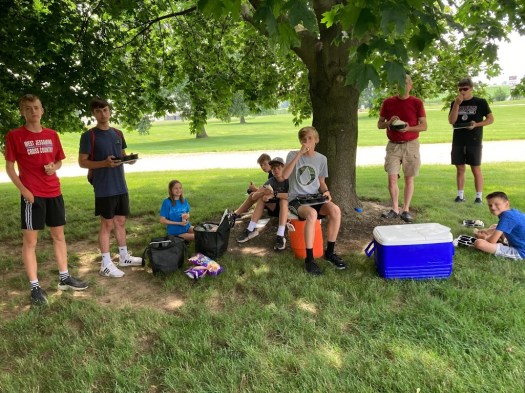
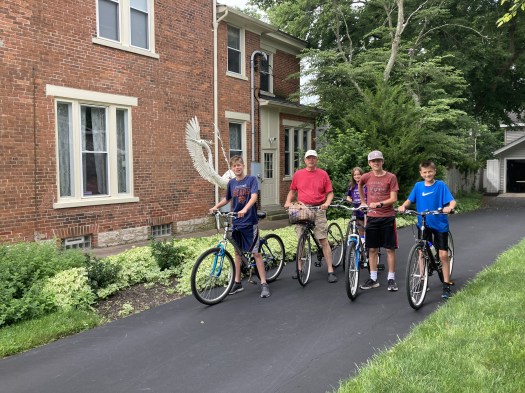
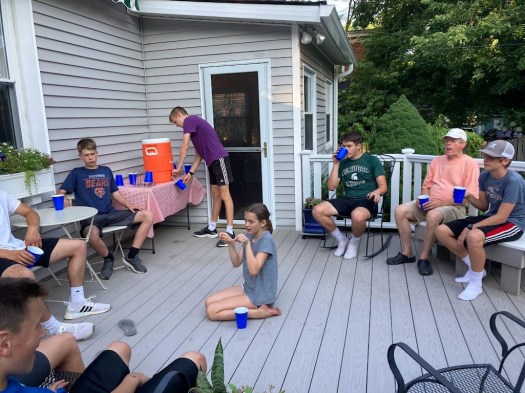
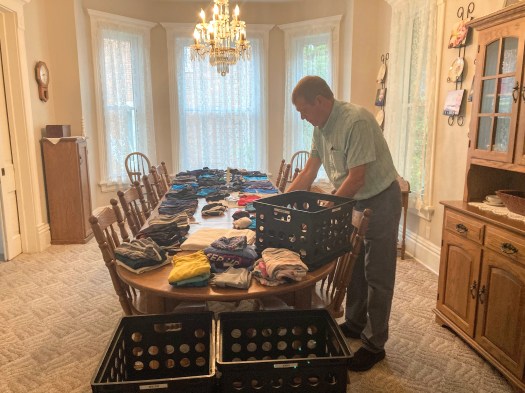
And these photos show why:

Eating with Great-Grandparents
Eating On the Go
Biking
Learning About Anabaptist History
Walking
Taking Risks
Reading
Hanging Out
Folding Laundry
Riding Roller Coasters

The Most Wonderful Time of the Year

They’re coming. They of the ferocious appetites, who prowl through the kitchen two hours after a meal, who chug milk by gallons and devour hamburgers and pasta and eggs and bread and, actually, vegetables.

For the past seventeen summers, they’ve descended on us. This used to mean changing diapers and tying on bibs. In those first years, they were easily entertained with backyard sprinklers and Plasma cars and Razor scooters. For hours they painted with water—the walls of the garage, the picnic table, the doors all around the house—and marveled at their handiwork. They colored pictures as we told Bible stories.

They went to bed early back then, and shook us awake at the crack of dawn. During their long afternoon naps, we’d catch our breath. Now we can breathe long into the morning. Their internal clocks now hold them to their cots. And as they sleep on and on, their pituitary glands release growth hormones. The tables have turned. Now it is our turn to shake them awake.

They may slog through their mornings. But at what is our usual bedtime, they become fully alive. And if we want them to talk with us, we need to adjust to their schedule. It’s like we change time zones without leaving home.

We’ve traded in Plasma cars for roller coasters and kayaks for sprinklers and crayons for discussions on how to bring a bit of heaven to earth. We take them to outdoor dramas—this year Trumpet in the Land, the story of the brutal massacre of 96 pacifist Moravian Delaware Indians by an American militia. And we cook together and do dishes and visit their great-grandparents, just three blocks away.

Cousin Week, I know, won’t last forever. We’re headed for our dotage and they for adulthood. But for this time of life, Cousin Week, for me, is the most wonderful time of the year.

My Nonagenarian Parents Take a Road Trip

If you’re losing hope in humans, try taking my parents on a road trip. Both in their nineties, they don’t travel often. So you’d have to find a good reason to entice them to pack their bags.

Last weekend held the best of reasons—the Benders were gathering. When my Grandpa Bender married my grandma, he wanted twelve children. He didn’t get his wish. My mother was one of only eleven. But he might have been satisfied to know the most recent tally of his family: 11 children, 55 grandchildren, 165 great-grandchildren, 274 great-great grandchildren, and 34 great-great-great grandchildren, for a total of 539 offspring.

Of all these people, my mother, at age 94, is the oldest living descendant. And last weekend, she was determined to fill her matriarchal role by showing up at the reunion.

So we packed pills and pillows and warm wraps and a cane and headed east, toward the mountains of Western Maryland.

Benders enjoy telling a good story and laughing and eating. Most of all, they take joy, deep joy, in people. They watch babies’ faces and chuckle over toddlers’ antics and applaud as teenagers try their wings. And to grow old among the Benders is to receive deference and honor. So I knew my parents were making their way toward kindness.

What I didn’t expect, though, was so much kindness along the way.

To keep blood flowing and joints limber, we stopped every hour. And at each rest break, kindness practically sprang forth.

People stopped their cars to let us cross parking lots, leapt to open doors, and waited patiently as we blocked their car doors in order to help our parents hoist themselves back into the van. Once at McDonalds, the restroom was crammed with high school girls talking over each other, scrolling on phones, and comparing shades of lipstick.

My mom stood in the doorway, taking it all in, wandering how she’d ever make it through the crowd.

One girl recapped her lipstick.

“Good morning, ma’am,” she said.

And the Red Sea seemed to part. Girls practically fell over each other as they stepped back to give my mom passage to the front of the line. A smile was on every face, including my mom’s.

“Tell me where you’re all going,” my mom said on her way out.

So they stood there talking, my mom with her wrinkles and these freshly made-up girls, who had paused their scrolling.

It was almost like we were already with the Benders.

Just One More Day

I felt a panging last week, one I didn’t expect. Afterall, I’m glad to be retired. I’ve not missed high-stakes tests and staff meetings and 4:30 A.M. alarms. But the morning I read about the walking classroom, I wanted to teach again.

Why hadn’t I thought of this idea?

It’s not like I didn’t have the theory. In college, I read John Dewey, who said students learned by doing. In graduate school, I studied Howard Gardner, who said there were multiple ways to learn, one of them using the body. And at a conference on brain research, I saw proof that brains work better when bodies move.

So I tried.  

I broke study sessions into chunks with exercises breaks. And when I saw eyes glaze over, I invited the class to stand up, breathe deep, and shake it off.

This helped. The exercise instantly woke the sluggish. It got their circulation going, moving blood from legs, where it had pooled, up into brains, where it could do some good.

But the conceivers of the walking classroom take it further. Instead of alternating moving and learning, they bring the two together. It’s a simple pairing of an old-fashioned walk with modern technology.

Through buds in their ears, students listen to podcast lessons as they walk. The part of the brain that makes the body move also brings about learning. So on this listening walk, double the neurons are popping, and brains are flooding with feel-good chemicals.

Students don’t know all this, of course. They just think it’s a fun way to learn. And, on test days, they appreciate how these lessons stick.

I’ve long known that, for some students, movement is a must. But the walking classroom recognizes that it matters for all.

If only I could have one more day in the classroom . . . but without a 4:30 alarm.

It Happened Again Last Week

It happened again last week. To each of us. At a store, someone asked me for help. And at a restaurant someone thought my husband Steve was a celebrity.

“Are you actually John Ritter?” a waiter asked. And he pulled up a photo on his phone to show us the likeness.

When we visited Boston one summer, people approached Steve three times asking if he was a Kennedy.

But mostly they want to know if he’s Robert Redford, the last time being this spring after a hike at the Clifton Gorge, right here in the middle of small-town Ohio.

I’ve never once been mistaken for a movie star. But I am in demand.

“Excuse me, ma’am,” people ask in Macy’s, “Could you tell me where to find a size seven for this shoe?”

At the library, they want me to point them toward the biographies. At Home Depot, they ask for brass pipe fittings. At the history museum, they can’t find the Civil War exhibit.

Maybe it’s because I’m a teacher. I was taught to walk tall and stand confidently, especially when I felt like shrinking back. Your lesson begins, my mentor told me, the moment your students set eyes on you. This first, immediate impression can shape your semester.

My students at the middle school and the prison and the gifted program all affirmed what my mentor said. Not in so many words. But it was clear. On the days I walked into class, closed up and collapsing into myself, they were glad to take up the space. And those were not good days.

But on my expansive days, when I was open and free, when I stretched out across the class, students gave me the room I needed to teach.

In this way, I learned to walk the classroom aisles.

And this apparently generalized to the aisles at Macy’s and the library and Home Depot and the history museum.

I must be losing this bearing, though. It’s not happening as often. And I’m becoming surprised when someone says, “Excuse me, ma’am.”

But I hope celebrity spotters keep finding Steve. Given my work-a-day, ordinary life, it’s entertaining to hear someone ask my husband if he’s Robert Redford.

The Defacing

Today I discovered how one of my younger siblings spent a long-ago afternoon. I just don’t know which one, though I have my guess.

And I don’t know what prompted the defacing of the picture book I found in some old things my mom was sorting. But I have my hunch about that, too.

Likely a new baby had come to our house. This happened often. And this is when my mother would gather us around and read Our Baby, a Ding Dong book by Dr. Frances R. Horwich.

Miss Frances, as children knew her, hosted Ding Dong School, the first preschool series of the air, a precursor to Sesame Street and Mister Roger’s Neighborhood. Miss Frances opened every episode by ringing a school bell, and she insisted that camera lenses be angled so that kids could see everything at what she called a Lilliputian eye level.

Not having a television, we didn’t know any of this.

We just knew that Miss Frances had written a book about Jack, whose house didn’t look much like ours, especially when a new baby came to stay. At Jack’s house, everything was evened up—cushions on the couch, stacks of folded diapers, towels hanging on holders, and blankets on beds. The grandma’s apron was starched and flouncy, the father wore a suit and tie, and the mother looked as if she had just come off a wellness retreat.

One day, after Mom read Our Baby to us, one of us must have crept away to a secluded corner with the book and a ballpoint pen. And at the end of what was likely a therapeutic hour, the house in the book looked more like our house. The pen left scrawls across happy faces and scribbles all through once-tidy rooms.

What intrigued me most, was that on every page in the book, a pair of eyeglasses perched on every face, even on the baby.

What did this mean? Though I took a semester-long class on interpreting children’s art, I don’t know. Maybe Jack’s family needed some flaws. Or maybe, with no television to watch and a fussy baby in the house, drawing eyeglasses was just a way to while away an afternoon.

A New, Age-Old Hack

“Guess what’s all the rage now,’ my husband said to me, looking up from his digital newspaper. “It’s got a new name, but it’s exactly what we did when we first got married.”

Cash stuffing, it seems, is all over TikTok, where young consumers are urging each other toward this low-tech, age-old hack on how to stick to a budget.

Back when we were newlyweds, we’d been shocked by the cost of living. Who knew that heating a small house could cost so much? And the bills kept coming—groceries, car insurance, appliance repair, and quarter after quarter of college tuition and books.

To make our money outlast the month, we labeled envelopes and stuffed them with the cash we budgeted for each category. The first Friday of each month, I’d pull bills from the Groceries: Week 1 envelope to take to Meijer, an expansive new store offering a plethora of foods, most of which never landed in my grocery cart.

One spring break, though, we found that cash stuffing carries risk.

We were packed for a road trip to visit my parents. Just as my husband turned the car key, I had a thought.

“Could you wait a minute?” I said to him. “I have one more thing to do.”

He turned off the ignition.

Back in the house, I lifted the tin box of newly-filled envelopes from the bottom filing cabinet drawer. This box held our living for the next month. And I was having an uneasy feeling. I cast my eyes around the room, and, on impulse, stuffed the box under the dirty laundry in the hamper.

Whoever broke into our house that weekend didn’t find it, but not for lack of trying. The thief emptied filing cabinet drawers and riffled through cupboards and rummaged in closets. But our cash was safe.

Cash stuffing might not have been fool proof, but it did curb our spending. With credit and debit cards, we could have lost track. We could have derailed our budget and accumulated debt.

And I hope this new, age-old hack going virtual on TikTok also helps today’s young consumers make their money outlast the month. 

With the Sun In Mind

More than a century ago, someone gave me a gift. Scarcely a day passes that I don’t give thanks to this unknown person, who understood how the sun moves through the sky and who used this knowledge to design our house.

Now that I’m retired and no longer turning off my alarm long before sunup, I see the rainbows that move across our white bedspread as the sun rises. They come from the beveled glass of an east window­. As it catches the light, it acts as a prism, splitting what was white into colors.

I’d be reluctant to leave the bedroom each morning, except that I don’t want to miss what’s happening downstairs. In the living room, transoms top the east windows. And the light that filters through their textured, colored panes, casts a rippling, rose glow over the room, a gentle welcome to the day.

All along its path across the sky, the sun shines in on us, through one window and then another. But it saves the best for evening. Having reached the west side of the house, the sinking sun sends its light through the amber and purple window panes on stairway landing. And the foyer below is sprinkled with sunset colors.

Our old creaky house is full of windows—forty of them, many stretching from near the floor almost up to the ten-foot ceilings. We feel their numbers on window-washing day. With few blank walls, it’s hard to arrange furniture and to make Zoom calls. These windows increase our heating bills and decrease our privacy.

But I wouldn’t trade them. The changing light elevates my energy and brings beauty and cadence to my day. And all because someone in 1872 thought to designed with the sun in mind.