It Must Be Something!

We’ve been spoiled this year, for sure! A trip through Europe with our son and his family. And now we’re flying again—to visit three countries new to us but ancient in civilization: Egypt, Jordan, and Israel.

For the first leg of our journey, I sat beside a young man headed to France to teach English. He’s giving teaching a try, he told me. He might like the classroom.

“But I have another idea,” he told me.

Though he had seemed travel fatigued a moment before, he became suddenly buoyant.

“I’m thinking of urban planning,” he said.

I waited, sure more was to come.

“You know what I’d like to do?” he asked. “I’d like to develop a network of trains across the United States, like in Europe.”

I hesitated, not wanting to spoil his dream.

“Did you know,” I asked, “about the interurban railroad?”

“Tell me,” he said.

And so I told him how, a hundred years ago, the interurban electric railways crisscrossed the United States, how even a kid could hail a railroad car from in front of the house where I now live in London, Ohio, and go to the big city to see the Columbus Buckeyes play ball or to a movie in Springfield, or just keep going all the way to Chicago to visit a grandma.

He looked at me as though I had ridden the interurban myself, as if to him, a hundred years seemed endless.

“It must be something,” he said, “to know what happened all those years ago.

We each turned to our own devices—me to my computer and him to his phone. But his last words stuck. After all, we are going to places where we’ll delve into millennia, not centuries.

Mr. Determan has Died

Mr. Determan has died. This is what a friend told me the last time I visited Flint.

I wish I hadn’t lost touch with him, that I had told him thank you for saving my junior high years. As the principal, he looked out for hundreds of kids. But he noticed me, a country girl from the mountains trying to fit in with city kids at a big school.

He could tell I needed a place, and he gave me one—in his office. I filed papers for him and answered the telephone and pulled students out of class when he needed to see them. And little by little, I learned to walk the halls with my back tall and my shoulders square and a smile on my face.

One afternoon Mr. Determan asked if I’d be willing to run the elementary school office for the afternoon. The secretary was sick, the elementary school principal was at a state meeting, and they couldn’t find a substitute.

“Call me if you can’t figure something out,” Mr. Determan said, and I caught a challenge in his eyes.

I ran the elementary office, but without calling Mr. Determan.

This is my first day to work for a school, I kept thinking all day. Maybe I can make things happen. Maybe I can be a teacher.

A few weeks later, my dad handed me an envelope that had come in the mail. Inside was a check from the Bendle School District–$25 for running the elementary school office. This seemed a fortune, and I used it to start my college fund.

The money didn’t go far, of course. But Mr. Determan’s intervention did. In those fraught junior high years when I was spiraling down, Mr. Determan caught me.

You can be different, he helped me see, and still find your way.

Good Kid; Bad Kid

Good kid, bad kid—I’ve done this myself.

I’ve scanned class rosters at the beginning of a term looking for last names.

Having taught for several decades in the same district, I knew the names. Harris, I’d read, and groan. Not another Harris!

But further down the list, I’d spot McBride.

Well, good, I’d think. That will make up for another year with a Harris.

Always I felt guilty about this kind of thinking. Usually I had enough professional sense not to say any of this aloud. Still, it was there in my mind—McBride, good, Harris, bad.

And since Harrises had demonstrated over and over that they’d do the wrong thing, I’d watch them more closely.

And so I’d catch them more often.

In the last decade of my teaching, I was scrolling through YouTube one day and happened upon this selective attention test. I watched it once . . . and again and again.

It got me to thinking. And to watching more judiciously.

I began to see that sometimes good kids agitate bad kids. Not much. And never loudly. Just a rolling of the eyes at a wrong answer. Or a brushing against a desk on the way to the pencil sharpener. Or putting invitations to a party on every desk but one.

But it’s enough—yet another rejection—for the bad kid to make a commotion. A loud one, which is obviously punishable, obviously confirming badness once again.

And the good kid can draw back in horror, away from this badness, confirming innocence, once again.

Harrises and McBrides—good in each and bad in each—as with all of us.

Thoughts from a Porch Swing on the Paving of Main

Outside our house, the trucks are gathering—milling machines and sweepers and pavers and rollers. And at the end of the day, the old, tired pavement on Main Street will have been ground up and swept away. And in its place, the beauty of a freshly-paved road.

“You want to know about the street you’re paving?”—this is the question I’d like to ask the flaggers and machine operators.

Main Street is wide. They must be noticing this. It was laid out in 1811 to be “eight poles wide,” broad enough for a carriage and four horses to turn in the street. And the houses that line it were built to show the periods—Italianate, Renaissance Revival, Queen Anne Victorian, Gothic.

But what the machine operators can’t see is the history under their wheels. One Sunday afternoon in 1925, for example, several hundred Klu Klux Klan members marched down Main. The parade was headed by thirty girls dressed in white, followed by a band and the Klan ranks. Overhead an airplane flew, dropping flowers on the marchers. The Klan marched from the park, passed the house where we now, live to the courthouse lawn. There they knelt to pray in front of a burning cross—Thy kingdom come, they chanted together, “thy will be done on earth as it is in heaven.”

The flaggers standing out there in the middle of Main directing traffic probably don’t know that at one time, interurban tracks ran down its center. Anyone, even a kid, could walk out of a house on Main and catch the interurban train to Columbus, the nearest big city, or go all the way to Chicago or New York.

I like living on Main, down the street from the courthouse with its columns and capitals and campaniles. I like hearing the bell in the clocktower ring out the hours. I like living across from the Coover House, built to bring culture—literary meetings and lectures and house concerts—to town. I like my everyday walk past houses built to show architectural variety.

But all has not been beautiful on Main Street—not in 1925, and not since.

Main Street is wide, but it’s also deep.

Racing Trains and Swallowing Chains

Most people would say I have some sense. But I didn’t always. Take for example, the day I tried to beat the train. I heard it coming. I saw the lights flashing. But I was young and in a hurry. And I made it across the tracks. Barely.

What if I hadn’t? This bothered me for a day or two. I was more cautious the next time I saw the flashing lights. But mostly I managed to bury this gaffe down somewhere so deep I almost forgot.

Until I kept meeting my younger self in middle school classrooms.

“What was he thinking?”

My colleagues and I asked this question a dozen times a week. Why would a kid smash a fist through glass, light a trash can on fire, jump from the fire escape, dart in front of a bus?

“A good kid, too!” we’d often add, shaking our heads.

In the back corner of my classroom one day, I saw the strangest sight ever. A quiet student, one who never made trouble, sat stunned by what she had done. One end of a chain hung from her mouth and the other end dangled out of her nose.

“It worked,” she whispered to me. “I swallowed a chain through my nose.”

Why?

I didn’t tell the chain swallower about the obvious mismatch in her brain. Its emotion center was in full swing, for sure—looking for pleasure and risk and novel experience. Her frontal lobe, on the other hand, the part that brings good judgement, had not yet matured.

Not only mismatched, for teens, these brain parts are also not well connected. It’s like the nerve impulses traveling between the emotional brain and the judgment brain are pushing their way though unplowed snow.

And herein lies the job of teachers and parents—to travel with teens through the drifts over and over until the road has opened.

I once raced a train, I’d tell myself when I lost patience. I’m glad my teachers stuck with me. After all, it’s the teens with adult traveling companions who turn into thinking adults.

Statistics, a Tightened Brain, and Teaching

I walked into the first day of statistics with my amygdala pinging away. Nearly five years into teaching and after studying the brain in graduate school, I recognized the signs. My brain’s alarm system had spotted danger. This is why my amygdala, a tiny, almond-shaped mass of gray matter behind my eyes, had sounded the alarm.  Now stress hormones surged through my blood causing my heart to pound, my palms to sweat, my knees to shake, and my brain to tighten.

Looking around the room, I could tell I wasn’t alone. Grim expressions, hunched shoulders, and crossed arms showed that others, too, were fighting statistics anxiety.

The professor stood in front of us and for a long moment took in the room. Then she opened class with the sweetest words I could imagine from a statistics professor.

“I failed graduate statistics,” she said. “Twice.”

Our eyes moved from our desk tops to her.

“And when I finally passed,” she went on, “I decided to teach statistics.”

She lifted her chin.

“And I’ve figured it out. I know how to teach statistics to you so that you won’t fail.”

She had us.

And she kept us.

All through probability properties and discrete distributions and univariate transformations and convergence of random variables, she safeguarded our confidence, making a way for our logic. She used analogies and humor and shared the blame when we were confused.

“Let’s go at this a different way,” she’d say. “I’m going to try harder.”

So we tried harder, as well.

And though the class was tough, with fear removed, I could grasp statistics.

But I learned something besides statistics, something I still carry with me—to actively fight fear in the classroom. With fear gone, the brain can reason. And clear thinking is what statistics—and all of learning—is about.

My Dad and Johnny Muskrat and the Sears Roebuck Company

When my dad was a kid, he sold furs to Sears Roebuck. Each fall when animals had developed a full-furred winter coat, he set traplines along fence rows and creeks on his family farm.

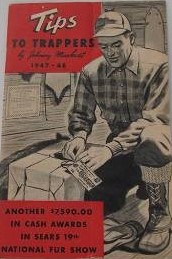
The pelts he sent to Sears was graded by experts, with extra bonuses paid for top-notch furs. So when Sears offered a Tips to Trappers magazine, my dad signed up, hoping to increase his earnings. In its pages, he read articles by “Johnny Muskrat” about the best ways to trap animals and prepare pelts.

One tip from Johnny Muskrat changed my dad’s trapping practice.

The further north, the better the furs, Johnny Muskrat wrote.

My dad realized he hadn’t been considering geography. He had been setting traps all over his family farm, paying no attention as to whether he was setting them to the north or south or east or west.

But he believed Johnny Muskrat. So he moved his traps to north-line fences, hoping to increase the quality of his catches. And it might have worked. In 1941, when he was eight years old, he sold a possum pelt for 25 cents.

“That was a lot of money back then,” he says. “Worth nearly $5 today.”

My dad likes to tell this childhood story on himself. He uses the story to help people understand perspective. When he read what Johnny Muskrat wrote about the north, my dad’s world hadn’t yet widened enough to know about places where furs grew thick against temperatures low enough to shatter trees. His thoughts on trapping fell in the bounds of his small world on a mountain farm in western Maryland.

Look beyond—this is what my dad’s story teaches.

Ninety-four Years . . . and Writing

I just bought my mom’s ninety-fourth-birthday gift. And she told me exactly what she wanted.

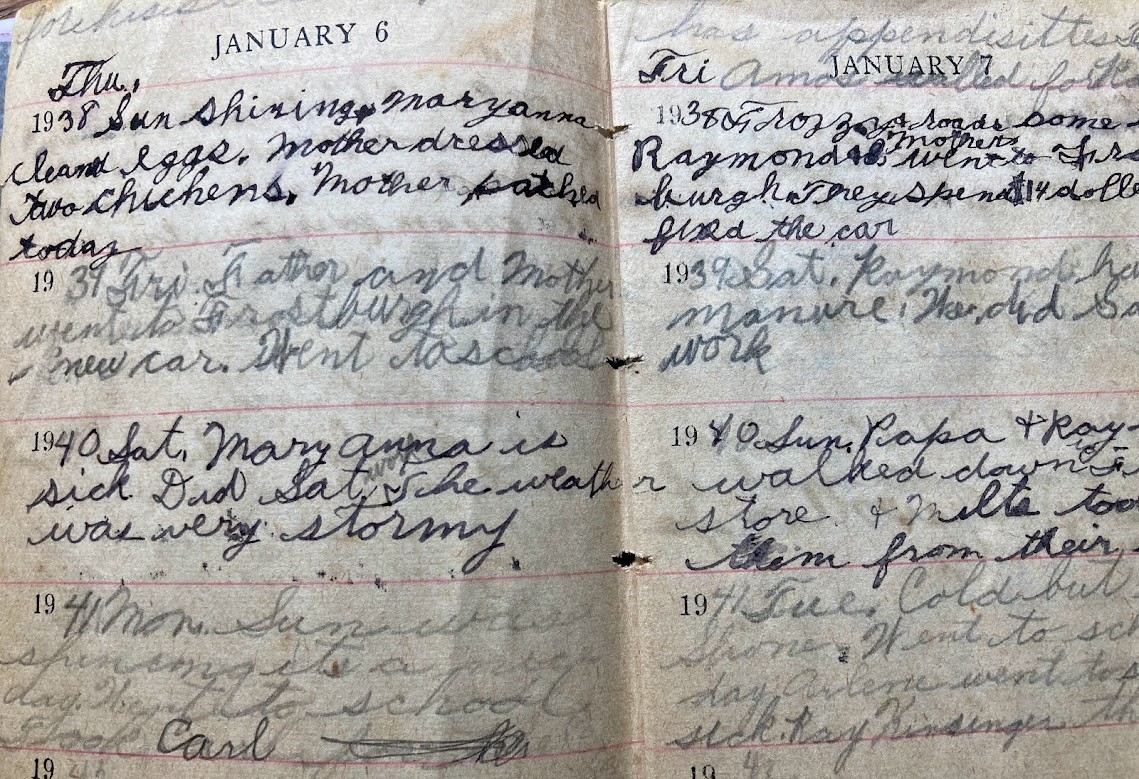
She has been looking forward to this gift for the last five years, ever since she came to me with a problem. The four-by-five-inch diaries she had been using for 84 years, the ones with room enough for only a snapshot of the day, were too small for her failing eyes and too cramped for her arthritic hands.

And, besides, she had explained, her life had become too full to be captured in the one inch of space allowed.

“But I don’t want a one-year diary,” she said. “I want to be able to look back and remember.”

So I found a five-year diary almost twice the size, one that lay flat when opened. And now, five years later, she has filled that diary—all but the last months remaining in this year.

“You said you’d buy me another one if I filled this one,” she said yesterday. “And my birthday is coming.”

So I ordered a diary that could take her to her 99th year.

“Are you keeping a diary?”—this is a question she likes to asks me. And my sisters and brothers. She asks her grandchildren and her great-grandchildren.

Mostly we hang our heads and say no.

But some of us try. A great-grandson posts on Instagram. A granddaughter keeps a bullet journal. I’m making a record of this year with a Second-a-Day video.

“Good,” my mom says.

But there’s a hesitation there. These modern diaries don’t quite seem to count.

And when I see all her diaries in one place, when I pick them up and leaf through the pages written in the early years with pencil and fountain ink and later with a ball-point pen, and when I know that in the next drawer down are decades of her mother’s diaries, I get her point.

Mostly my mom’s diaries address the everyday, the quotidian. They’re about canning peaches and milking cows and ironing and doing field work. And they’re about who has a fever and pneumonia and the stomach flu and scarlet fever and polio. They’re about who dies.

The diaries tell about ordinary days on a farm in the mountains of Pennsylvania during the Depression and World War II. My mother writes of becoming a mother and our family’s big move in the sixties to the gritty auto city of Flint, Michigan. She keeps writing as her children grow and their children are born and their children. And she records the deaths of her brothers and of sister after sister.

I hold her diaries in my hands and watch her writing turn from a girlish scrawl to fine penmanship and finally to a shakier script. And I’m almost convinced to keep a diary.

But not quite.

Come See My View

When I walked past the open door, she stood inside, her arms loaded with damp towels and unlaundered sheets. I felt a pang. I was headed out to explore San Francisco with my husband and grandsons. And she would spend her day in the hotel, cleaning up after us and other vacationers.

Just before I pushed the elevator button, I heard a voice behind me.

“Ma’am?”

I turned, and she stood back the hallway, her arms now free of towels and sheets. Before she spoke again, she searched my face.

“Ma’am,” she said. “Come see my view.”

And in case I didn’t understand her accent, she beckoned me into the room and over to the window.

“Look,” she said, “what I see every day.

And from that window, she gave me a tour of the city.

We marveled together over the Golden Gate Bridge, shrouded in fog, and the hills that define the city and Alcatraz Island squatting in the bay and pelicans flying over the water. Her voice took a tone of reverence.

“See there,” she said, “the Palace of Fine Arts.”

Squinting I could see a domed rotunda with golden colonnades. And I decided to convince my grandsons to visit this taste of Rome. She pointed toward Coit Tower, stretching straight and tall into the clouds. And we looked together at the blue-tinged mountains beyond the bay.

“My view every day,” she said, as she turned back to the towels and sheets. “Thank you for looking with me.”

But my thanks was to her. All day this conversation followed me. I didn’t forget it the next day, or the next. This is a conversation I’ll carry with me, hoping to remember especially when I need to widen my view.