Lots of Coffins and a Writhing Mouse

By age four, I had seen plenty of dead people. At our church, whole families went to every funeral. So lots of little kids filed past lots of coffins.

We’d stand on tiptoe to look at the dead grandmas and grandpas. They’d lie there, hands folded across their chests and eyes closed as if in deep, peaceful sleep.

They probably like it in there, I thought. They’re probably tired of creaky knees and bent backs and hobbling around with a cane.

I never once thought, though, about how these grandpas and grandmas died. Not until one sunny afternoon when I was riding my tricycle. I had just passed the milk house, when I heard a tiny scream.

On the sidewalk, a mouse writhed in pain. Under the paws of a farm cat, its grey fur was laid open. Blood stained the sidewalk.

I covered my face with my hands. But unable to look away, I peered between my fingers until the screaming stopped and the mouse went limp. And I knew the mouse was gone.

The blood could never go back into the body. Never again would the mouse take a breath or nibble on cheese or run across the grass or hide under a leaf.

I might have seen lots of dead people reposed in their coffins. But the screaming mouse awakened me to the pain of mortality. It showed me that, though death might be like sleep, as the Bible verses so often said, dying was sometimes terrible. And at the next funeral, I was not so quick to assume that dying was an easy answer for the old.

How had those grandpas and grandmas died? How would my mom and dad die? How would I die?

I went to my parents with questions about how to live with hope when I knew they would die someday, when I knew I would die, when none of us knew how we would die.

They helped me begin to understand that death is a natural part of life and that, like life, dying can be hard.

I didn’t like what I was understanding. I had hoped all the grandmas and grandpas fell gently into death without pain. This new knowledge did one good thing—made me feel more grown up. And that helped. Though not enough to keep the screaming mouse out of my dreams.

But despite those dreams, I quit asking questions. I somehow felt I didn’t want to grow up anymore. At least not for a long time.

Don’t Shoot the Grandma!

“Don’t shoot the grandma!” the kid yells.

A few blocks into my evening walk, I’m paused uncertainly on the edge of a Nerf-gun battle that spans the sidewalk. Some kids are sprawled on the ground, apparently wounded. Or dead. But the rest are shooting and dodging and yelling.

“A grandma!” the kid yells again.

And it’s a cease fire. They skid to a stop and point their guns to the ground. They stand silent, peering at me from behind their goggles as I step over Nerf darts and around the dead and wounded. As I clear the battlefield, some call out to me.

“Have a good day,” they say.

And I do.

There’s something real nice about being my age. I’m in the phase of aging called the young-old. Coming next, around age 75, is the middle-old. And then comes the old-old, which describes my parents.

It could be that for me, this young-old stage is the best of life. No longer getting on the treadmill at 4:30 in the morning, I sleep more each night. After fending off school-room germs for so many years, I have fewer garden-variety ailments. I worry less about other people’s opinions, juggle fewer inescapable obligations, and enjoy senior discounts at restaurants. I have stories to tell and more time to chase my dreams.

But perhaps the most satisfying perk is that when I’m out and about, I keep running into kindness. People open doors and carry my groceries. They stop their cars and motion me across the street. They help me with technology. They smile and call me ma’am.

And now I’ve discovered that they even stop battles by yelling, “Don’t shoot the grandma!”

Words from Sap Pails

“It was sort of romantic,” my dad says. But he isn’t speaking of my mom, not this time. Instead, he waxes nostalgic about sugaring season, when nights are cold and days are warm and sap rises and it’s time to tap the maples.

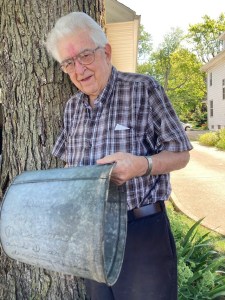
In his hands my dad holds a sap pail, one he held a little over seventy years ago. We know this because right there on the pail is a message he scrawled: David is tapping. Oscar Maust and I are driving spiles. Rachel and Alan are handling sap pails. February 19, 1954.

You can find other messages like these on the hundreds of sap pails, also known as keelers, that came from my grandpa’s now defunct sugar camp. On those keelers, you can read about snowfalls and weddings and births. Here are some sample messages from the 1920s:

April 3, 1920—Cousin Olen Miller left for Del. again last night at about 2 o’clock. Yesterday was Good Friday, and the singing was at Uncle Milton Miller’s.

April 20, 1920—Putting away the keelers. Quarantined for scarlet rash.     

February 14, 1921—This keeler is at the tree behind the barn.

It was fun, my dad says, to read these words every year as he washed and scalded the keelers and loaded them into the box spring wagon to distribute among the maples.

As I read these messages on the keelers, I think of words I’ve seen carved into school desks and spray painted under bridges and marked on prison walls. I think of Facebook and Instagram, of Tik-Tok and Twitter.

We all, it seems, have the urge to leave marks behind us, to show evidence of having once been alive in a particular place at a particular time.

And I’m happy to now own the sap pail my dad holds in his hands and to hear him remember that time and place.

.


A Mourning Walk

The other evening I set out for a sad walk, not to count my joys, but to mourn my sorrows—the cancer diagnosis of someone young and dear to me; the precariousness of life for the old, especially my parents whose knees and eyes and shoulders and body systems show their ninety years; the anguish of friends who struggle with broken relationships and poor mental health; the ravages of war; and the fractured American church.

The weight of these thoughts fell on me, and it seemed all energy had drained from my life. I must have looked like a hunched-over old woman plodding down Main. And, come to think of it, that’s exactly what I was.

Absorbed in troubles, I didn’t at first notice when a fancy black car pulled over along the road beside me.

“Mrs. Swartz, is that you?”

The voice was a little doubtful. And no wonder. I looked a hundred years older than when he had seen me last, walking school hallways with a jaunt.

It was Asher. I could still recognize his middle-school face. While I had grown old, Asher had grown up. There he was in his fancy car with his girlfriend, both of them alert, lively, and full of hope.

“Couldn’t tell if that was you,” Asher said. “But I stopped just in case. Wanted to say that you changed me from a rowdy, always-in-trouble kid to one who cared.”

Asher had just become a police officer in our town, and his girlfriend had just started medical school, aiming to be a surgeon.

“I’ll keep you safe,” Asher said, before he pulled back into traffic. “That’s my new job.”

His girlfriend leaned over him toward the window.

“And if you need surgery,” she said, “I’ll cut you open.”

Their words didn’t change cancer or old age and didn’t solve the problems of broken relationships and poor mental health and war and a divided church.

But they did change the rest of my walk.

At my age, I’m supposed to be wise. But I had been forgetting to embrace the view of the world in which opposites are joined, to see the world whole, not only with dewy-eyed romanticism or with only steel-eyed realism. I had lost track that life has two sides. One light. The other shadowed.

Like Asher, who had once brought me sorrow but now brought me joy.

On my walk home, I was still old, but no longer hunched over and plodding.

Seventeen Years . . . And Counting?

It’s coming again . . . my favorite time of the year. For seventeen years now our grandchildren have come to our house for Cousin Week. At first, just three, all in diapers. And each summer we kept adding.

In the early years, we pulled them in wagons and pushed them on swings and changed their diapers and read them stories. They spilled milk and lost pacifiers and skinned knees. They begged to be carried and fought over the favorite red ball.

At naptime, they recharged and we regrouped. And then we’d start over again.

Now, many of them could carry me. And we’re dealing with cars, not tricycles; with sports injuries, not skinned knees; with sinks full of dishes from late-night snacks, not spilled milk. They lose phones instead of pacifiers and discuss the origins of the universe instead of fighting over the favorite red ball. Now we camp and kayak and bowl and ride the bike path and stay up until all hours and sleep the morning away. And eat and eat and eat.

“Are the grandkids coming?” my favorite clerk at Kroger asks.

She knows.

But what I like more than all the things we do together, is that they still come to us, these young people, just beginning to spread their wings. They won’t keep coming, not like this. Their wings will take them other places—to schools and jobs and relationships. They’ll be going on, to make their lives.

But this year, they’re coming, all of them.

Back in our day, we sang these nostalgic lyrics: 

   We have this moment to hold in our hands
And to touch as it slips through our fingers like sand. . .
We have this moment today.

Being a grandma, I’m permitted this sentimentality.  

But being a grandma, I also applaud their futures, when our house will no longer be a week-long haven every summer. When, instead, they’ll be out there, somewhere, creating havens for others. And we’ll be watching and praying.

To Be Amazed

I’m working with my 91-year-old father these days. We’re making slide shows for three history talks he hopes to give this fall.

From his computer, he sends an image to mine. And with a few clicks, the image is where it belongs—in slide number 21.

We’d been doing this for weeks. But on this day, my dad falls silent for a moment. His eyes travel from my computer to his. And back again.

“I’m amazed,” he says. “What path did that photo take between our computers? Where all did it go?”

My dad learned this kind of talk from his dad.

Grandpa used to lean back in his chair after a good dinner of chicken and mashed potatoes. He’d cross his arms and prop his chin in his hand. And he’d marvel as he recalled the first cars on the public road or the first airplanes that crossed their mountains or the first electric lights that dotted the country side.

He had grown up, after all, with horses and buggies and butter churns. He had seen wool shorn from sheep and then and carded and spun and knit into clothing. No wonder he was astonished at the first space travel and the moon landing.

It’s hard, he’d say, for each generation to imagine what the next one will invent. And he’d tell what he read in the World Book Encyclopedia—that in the early 1800s, an employee at the patent office resigned because there would be no more inventions to patent.

If my grandpa could have seen my dad and me working on the slide show—collecting images of log houses and census records and newspaper clippings and church-vote tallies and putting all this together to be shown on a big screen at a history meeting—he would have been amazed once again.

And I’m like my grandpa and my dad, I can’t imagine what my grandchildren’s generation will create. As far as I can tell, there’s only one invention left—a sort of transport that can bring grandchildren across the miles, from their front doors to mine, in seconds, not hours.

Old Brains; New Math

When I was a kid, people loved jokes about New Math. Lots of people bought Tom Lehrer’s latest album with a song named New Math.

“You’ve got thirteen and you take away seven,” he sang, “and that leaves five . . . well, six actually, but the idea is the important thing.”

Even Charles Schultz cracked on New Math in his Peanuts comic strips.

“How can you do New Math problems with an old math mind?” Charlie Brown wails.

Sally agrees. “Sets . . . One-to-one matching . . . Sets of one . . . Renaming two . . . Subsets . . . Joining sets . . . All I want to know, is how much is two and two?”

I laughed at the jokes, but I liked New Math. It showed me how numbers fit together in ways that are precise and beautiful

New Math was invented because of Sputnik. Our American brains had gotten lazy, teachers told us, because we’d been given too many answers. But no more. Now we had to figure problems out on our own like the Russian kids. The Russians didn’t mollycoddle their kids. That’s why they were smart enough to launch the first artificial satellite into space. America needed to step it up. And this was why the president started NASA and the Space Race and New Math.

Like Lehrer and Schultz, some of the teachers didn’t like this new-fangled math, especially Mrs. Brandt. Sometimes she’d go on a rant. Just tell a kid that eight times seven is fifty-six, she’d say. No need to reinvent the wheel. And what do bases and sets have to do with the real world? If someone needs to figure out how much carpeting is needed for a room, they sure don’t need to know how to count in Base 5. Real arithmetic—that’s what kids need.

But sometimes I wondered. Maybe Mrs. Brandt said these words because she didn’t really understand New Math. She’d explain a lesson, but when we had questions or got stuck doing problems at the board, she’d act confused and start telling us it was our job to figure it out, not hers.

I’d look at Mrs. Brandt, with her white hair and her forehead knotted up with thinking, and I’d remember Charlie Brown wailing about doing New Math with an old brain.

This made me sorry for Mrs. Brandt, but not sorry enough to stop liking New Math.

You Never Know Who’s Watching

He never knew I saw what he did.

It was long after the school day ended. The winter sky was already darkening, and the teacher parking lot was empty, except for my car. I was working late.

From my desk, I saw the superintendent carrying a stack of paper from the middle school across the parking lot toward his office in the administration building. These were pre-computer days when everything in education—teacher evaluations, lesson plans, board minutes, long-term planning—all this and more generated mounds of paper.

The surfaces in Dr. Froning’s office might have been lined by stacks of paper, but he hated litter. He bought into the Keep America Beautiful campaign. He installed trash bins around school buildings. And he sent a clear message across the district: Be part of the solution, not the pollution.

Just as he passed the bus garage, a gust of wind blew a piece of crumpled paper across his path. It caught at the edge of a curb.

Dr. Froning stopped and stared at the paper. He took three more steps toward his office and stopped again. He turned back. Balancing the stack of paper he already carried, he bent to pick up the litter. He carried it to a trash bin and tossed it in.

I had watched Dr. Froning stick to his principles as he wrote policy and led meetings and addressed teachers in school-opening convocations. Decades later, I remember few of these public words. But I do remember this private act of integrity. And I recognize its call to me as a young teacher—to take the high road, even when no one watches.

In many ways, we become what others teach us at odd moments, when they don’t know they’re teaching. We’re shaped by bits of wisdom people drop along the way.

And little do we know that while we watch, others are watching us.