
Around the corner from us lived a neighbor who saved her life with a needle and thread. Walking by her nondescript house, you wouldn’t think an extraordinary woman lived there. You wouldn’t think the woman who lived in that house would be an artist, whose works appeared in galleries and museums worldwide. Nor would you think that this woman had, by miracle and a deft hand, survived Auschwitz.
She seemed like an ordinary neighbor, one who waved to me from her front porch when I passed and stopped by mine when she was out walking her Yorkies. She came to our children’s graduation parties, gifts in hand, I took homemade cinnamon rolls to her, and once my husband rescued her Yorkies from a snarling stray mongrel.
But though we were near neighbors, I never celebrated her artistic acclaim with her. Or mourned the Holocaust. It wasn’t her way. She didn’t want to be set apart by fame or by tragedy. She wanted a small-town life as unassuming as her house. For her, keeping silent left more room to make this happen.
It’s been more than a decade since my neighbor died peacefully in her bed. But this week, I mourned again. And because of a book.
“You need to read The Dressmakers of Auschwitz,” a friend told me.
And I did.
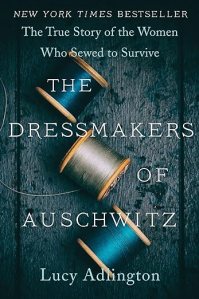
In this book, Lucy Adlington tells the story of women who sewed to survive. When clothes rationing hit Germans during World War II, elite Nazi women, Hedwig Höss among them, felt they were above the law. Höss, who was the camp attendant’s wife, had no intention of letting standards slip. No matter who did the stitching, she intended to look smart.
So she established a fashion workshop in the heart of Auschwitz and staffed it with skilled Jewish women who designed, cut, and sewed garments for the Nazi upper crust. At this workshop, the shorn, tattooed, hungry, grieving women stitched for their lives. And some survived. But when the war ended, the survivors discovered what they lost.
As she had been sewing, my neighbor learned, her husband of three months, her twin brother, and her mother had all been murdered. Her father had died before the war, so she was left as the lone survivor in her family.
Tonight, I walked again by the nondescript house, where my neighbor lived out her post-war life. I imagined her sitting on her porch, ready with a wave. But on this walk, I also made a pledge—to not to forget what I learned in Adlington’s book: that genocides occur in phases, that it’s possible to recognize these phases early on in hopes of stopping them, and that genocide can be facilitated when ordinary people stand by.
 Apple to Apple
I’ll add the book to my reading list.
LikeLike
Beautiful pearl of an essay, Phyllis. Everyone needs to recognize the danger that genocide can still occur. Let us not stand by.
LikeLike
Insightful Phyllis. This is probably my favorite genre- especially the ones based on actual events. Could it happen again….we must be alert!
LikeLike