
I didn’t know he was still alive. But there he was, in the photo my friend sent me. At eighty-six years, his eyes, still dark and penetrating stared out from dark, over-sized glasses. Unruly hair—once thick, springy, and black as coal; now white and wispy as smoke—still flew above his head.
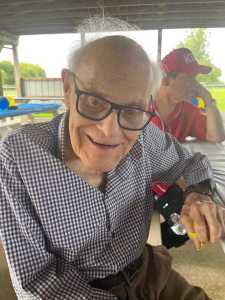
But it was his wide-set mouth that took me back. Mr. Wooten taught me history during the years of Watergate, the Vietnam War, and soaring inflation. Every day, something—like gerrymandering—set him off.
He’d start by working his mouth, first pursing his lips and then twisting them in displeasure. In seconds, he’d become so agitated about contrived, exclusionary boundaries, that words spit from his mouth in fits and starts. This spectacle startled kids from their stupors and made Frank Adkins, who hated school, lean over and whisper to me, “Now, what the hang’s gerrymandering?
The times were right for Mr. Wooten’s teaching career. He couldn’t believe his good fortune in having personally seen so many Supreme Court cases.
“The year you were born,” he told us, “was the famous Brown v. the Board of Education decision.”
Fred Adkins slouched in his seat as Mr. Wooten went on about how Brown v the Board overturned the earlier case of Plessy v. Ferguson
But it was Tinker v. Des Moines that got Mr. Wooten pounding on his desk one day.
“Just last year,” he said, “the Supreme Court said that students do not leave their rights at the schoolhouse door.”
The pounding roused Frank Adkins. He listened as Mr. Wooten told us how Mary Beth Tinker and her brother got kicked out of school for wearing black armbands to protest the Vietnam War. Mr. Wooten agreed with the justices. This expulsion violated the Tinkers’ first amendment rights.
Mr. Wooten stopped, as he often did, to peer at us from under his bushy eyebrows and wait, his finger drumming the podium. It was our turn.
If someone, usually John Jenkins, the class brain, said something approaching cleverness—something like, “If we don’t leave our rights at the school doors, how come you search our lockers?”—Mr. Wooten’s smile would crack through his crustiness.
We’d do almost anything for that smile.
And the smile was still there on Mr. Wooten’s now shrunken-in face, reminding me that he taught me more than history. He taught me what I tried to remember during my decades of teaching, that passion is the contagion that draws students in.
Thank you, Mr. Wooten.
 Apple to Apple
More wise words about the remarkable Bendle teachers you had! I love this Phyllis!!
Jan Koop
LikeLike
Thank you for this. I am flooded with wonderful memories of Richard Wooten and his magnificent command of the English language. I learned a lot from him too. We were so very lucky to have teachers like him.
LikeLike
Thanks for reminding me of Richard Wooten who had such a wonderful command of the English language and brought such excitement to the subjects he taught. We were so very fortunate to have Mr. Wooten and many others like him to expand our thinking.
LikeLike