
My dad quit school after seventh grade. Not that he wanted to, but his church thought seven grades was enough, that more education might take him away from the simple life and make him worldly. My dad was glad enough to be out of school that first summer. He wanted to run barefoot on the farm.
But this feeling changed one morning in early September as he plowed the field across the knob, getting ready to plant winter wheat. Plodding in the furrow behind Bob and Fern, the draft horses, he noticed bonnets and straw hats bobbling along the country road.
It’s the first day of school, he thought, and I won’t go to school ever again.
He wished in secret that someone would make the Amish Mennonites obey the law about going to school until age sixteen. But he knew he wouldn’t complain. This was the way of his people. He would learn at home like his father who read the Bible, and magazines like Newsweek, Farm Journal, and the Herold der Wahrheit. He would read his father’s books of poetry and theology and history.
Having settled this, he said, “Giddup!” to the horses. He gripped the plow handles, and field length by field length, row by row, he turned the fresh earth.
***
I sometimes think about that barefoot boy when I walk into my dad’s study for our daily visit. He’s no longer barefoot, no longer plowing fields. But he’s still holding to the contract he made with himself—to keep learning
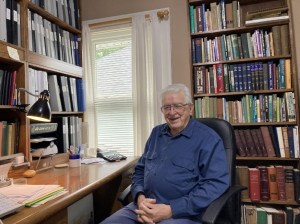
He read the books in his boyhood home. And later, after I was born and the church opened the doors, he went back to school. Not hanging on his walls, but somewhere in his files are two diplomas—one for a bachelor’s degree, the other for a master’s.
Now at ninety-one, he still spends most of the day in his book-filled study.
“Guess what I’ve discovered,” he often says to me when I walk in.
That’s my dad.
***
You can learn more about my dad in my memoir, Yoder School.


So many of our parents and their siblings’ generation embraced life-long learning. Young hands were needed on farms especially during the wartime years and formal schooling often ended as a result. But there were correspondence schools and trades to be learned and then mastered. While one dislikes the inconvenience of the pandemic’s effect on schooling, today’s learners might harken back to many stout examples of determined learning in years gone by to get their inspiration!
LikeLiked by 1 person
How inspiring! Hats off to your Dad!
LikeLike