
My sister sends me a photo—a beautiful, haunting photo of our childhood home. The day my parents sold this house with its forty acres, I muffled my sobs in a pillow, not wanting to make them feel worse for selling than they already did.
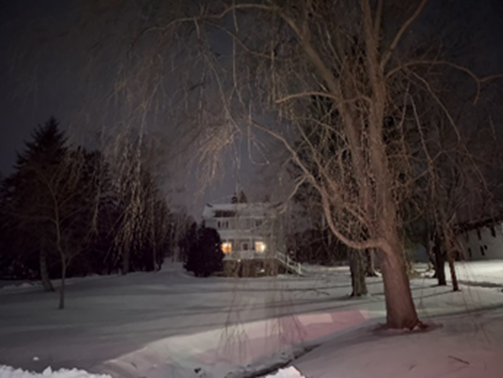
Just inside the lit window on the right, I learned to read. One morning, I sat on a low bench in front of a children’s bookcase. Words from books my parents had read to me began to pop out. And I saw them in a new way. I found them on other pages. And I was reading, really reading. At that moment, I wanted to know every word in the whole world.
In this house I worked my way through childhood diseases: mumps, measles, chicken pox, and rubella. And living here, I learned about death—watching our dog kill and eat a pup, hearing that my best friend’s papa died, finding a cold, still ball of yellow down while unpacking newly arrived chicks in the hen house.
Under the willow tree, my brothers and I teased the buck sheep my father tied there, dancing out of reach as we poked him with a stick.
“You children stop that!” my dad said. “You’re making him meaner than he already is.”
In the creek that wound through the yard, we waded and caught tadpoles and raced paper boats made from the pattern in a Curious George book.
So I had reason to sob into my pillow the day my parents sold this small farm called Willowbrook. My childhood as I knew it was over.
But not my childhood.
In the three-room school I left behind when my parents moved us from our country home, I’d read about city kids. What would it be like, I’d wonder, to buy treats from ice cream carts and ride a bike on level streets and walk to the library any old day I wanted without having to beg my parents to take me?
In the city, milk in glass bottles came to the milk box by our side door, The Flint Journal with its children’s section to our front door, and travelogues of the Swiss alps and the Sahara Desert and kangaroos in Australia to the IMA auditorium.
In Flint, I learned to play and talk with kids who didn’t look like me or talk like me or eat like me or believe like me. I learned to drive at Safetyville, a miniature village with kid-size cars and streets and traffic lights and even a bridge called Little Mac.
In the city-school band, I learned to play the clarinet and the saxophone and the organ. And In Saturday morning classes sponsored by the Mott Foundation, I learned art and writing and German.
That photo my sister sent—I peer into it again. It’s ethereal, giving me the illusion I could walk up the steps and open the door and find myself sitting on a bench behind the lit window. A longing comes through me for this most innocent part of my life.
And the girl who sobbed into the pillow—if only she could look back with me now. Not at this scene only. But at both halves of her childhood. Each of them rich.
Photo Credit: Oluchi Ekwegh


Like the picture, your writing is hauntingly beautiful. I wish I would have known you as a child at Willowbrook or in Flint. I think we would have been the quiet kind of friends who watched and read and felt content together.
LikeLike
Yes!
LikeLike