Background of a Blurb–Shirley Showalter

Back when I thought I had finished writing Yoder School,  I reached out to Shirley Hershey Showalter, who had already published her memoir, A Mennonite Girl Meets a Glittering World.

“Could you read this for me?” I wrote her. “And tell me if it’s ready to send to a publisher?”

Shirley had no reason to help me, except for a generous heart for a flailing writer. But she did. She asked insightful questions and, in a gracious and hope-giving way, made statements that were both hard for me and good for me to read.

And she set me on the way toward a much-needed revision.

So when Shirley agreed to write a blurb for the back of Yoder School, I was pleased.

“Because this story is so well-written, we the readers follow the narrator’s progress with the eagerness of a child at play.”

—Shirley Hershey Showalter, Author, Blush: A Mennonite Girl Meets a Glittering World, in the Foreword

My Dad’s Diploma

Dad's Graduation

In this picture, I wish my dad had his diploma in his hands. Because that’s what I remember most of that day—the diploma he held, often close to the level of my eyes. My dad had worked hard for that diploma. And it was important, I could tell. My dad wore a graduation gown, the speeches were long, and people were snapping pictures. That’s the day I made up my mind. When I grew up, I’d try my best to earn a college diploma.

A First-Grade Lesson I Still Use

I finished my work before most of the other students each day. So sometimes I whispered with Nathan and Gertrude and Ruth. We had been assigned seats together between the first graders and the second graders. This whispering didn’t seem like a big problem to me until I opened my first report card for the year. I liked all my grades, except the one for citizenship. I had a feeling my parents­­ wouldn’t like that grade, either. They were big on good behavior.

To my surprise, they didn’t say anything about my bad mark that evening. After supper while Mom rocked the baby, Dad dropped to his fours on the braided rug to roughhouse, my little brothers riding him like a horse and him bucking them off. Then Dad turned into a growling dog, pinching his bushy eyebrows together in a dark slash across his face and chasing them up the stairs to bed. I usually played these games, but not tonight. In bed, I wondered, had my parents read my grade wrong? Not seen it? Was I conscience-bound to point it out to them?

The next evening, though, they asked to speak with me. In her rocker by the window, Mom pulled my brother’s holey sock over her wooden darning egg and wet a thread so she could push it through the needle eye. I watched the needle flash in and out of the sock closing the hole. Dad rummaged in the desk for a package. Then he sat on the couch beside me. Both of them looked at me.

They surprised me again. We think we know, Dad said, why you have a bad grade in citizenship. How could they know? They hadn’t seen me at Yoder School. We think, my mom went on, that you finish your work too quickly. Then you don’t know what to do, so you talk to Nathan and Gertrude.

I was overcome with relief. My parents understood me exactly. I wanted to climb up on my mom’s lap, but I just nodded. Then they showed me their solution. A beautiful, shiny, brand new workbook. About birds. With stickers (which I had never seen before) and puzzles and diagrams and facts. I was awestruck. A wondrous book instead of a scolding.

“Do your school work as quickly as you can,” my dad said. “And then do this workbook. When you finish with this workbook, we’ll find you another one.”

And,” Mom added, “don’t talk to Gertrude and Nathan.”

Background of a Book Blurb

The whole time I was growing up, I watched Richard Showalter from afar. In some ways our childhoods followed similar trajectories. We both lived for a time in the mountains, both knew what it was like to live in Mennonite communities and to look back into those communities from the outside. But Richard was always just a little older, a whole lot wiser, and way more adventuresome than I was.

When we were adults, I kept watching as Richard made critical choices to engage. He rose to one challenge after another—teaching and pastoring and living in Kenya and the Middle East. He became the president of a college and of a mission agency. And he wrote books. Richard, I could tell, wasn’t afraid to be different, but he also seemed to know how to avoid hyper-partisanship, to reach across differences for relationship.

Like I had as a kid, I kept right on trying to learn from Richard, a person ahead of me on the path. And so when he agreed to read Yoder School and comment on it, I was delighted.

“Yoder School is an extraordinarily insightful memoir of an inter-culturally-seasoned Anabaptist educator journeying from an Amish Mennonite mountain school in Maryland through urban mazes of Michigan and beyond. Her razor-keen excellence in educational pedagogy, fusing love for students with inspiring them to learn, forms a page-turning narrative.”

—Richard Showalter, Columnist, Mennonite World Review, and Writer, Teacher, Mentor

A Book for Alvina

I get a handful of free books from my publisher, and I’m saving one for Alvina. She was my first teacher, the one who made me want to teach. And as I took class after class on the way to a teaching degree, I measured my other teachers and professors and eventually myself by Alvina. She was my yardstick.

12489340_10207835853750950_6693148379961045919_o

Alvina is the teacher. I’m in the front row with the blue dress.

Alvina is now 94 years old. The last time I went back to Grantsville, Maryland, I stopped to see Alvina. She remembered me . . . and my first grade reading score.

“I wrote a book,” I told her.

“Good for you,” she said. “I want to buy one. What’s it about?”

“You,” I said. “It’s about you. And I’ll be bringing you a book.”

Here’s the Cover!

Yoder School Cover

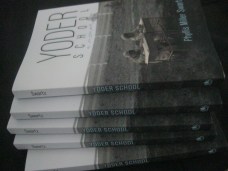
Here’s the cover of my upcoming book, Yoder School. The photograph, taken in the school yard, shows one small way teachers at Yoder School took learning beyond the classroom walls. At Yoder School time flowed, and subjects merged into each other.  And I couldn’t quite tell if I was working or playing. But I knew I was learning. In many ways, Yoder School set the foundation for my thirty years of teaching.

Here’s the Cover!

Yoder School Cover

Here’s the cover of my upcoming book, Yoder School. The photograph, taken in the school yard, shows one small way teachers at Yoder School took learning beyond the classroom walls. At Yoder School time flowed, and subjects merged into each other.  And I couldn’t quite tell if I was working or playing. But I knew I was learning. In many ways, Yoder School set the foundation for my thirty years of teaching.

Let’s Go To Print


Writing by the Fire“Let’s go to print!” I read these words in an email from my editor. And now my book Yoder School is at the press. I’ve never wanted to sky dive or ride roller coasters. But when I read this message, I felt a nervous tremor of thrill run through me—great pleasure mixed with some jots of anxiety. My book is about to go public.

Maybe I like to write because I’m an introvert. I’m no good at a party, never sure I can think of the next right thing to say, always wondering how some people gather others around them so effortlessly. But alone with my laptop, I feel free—exploring ideas and finding patterns that I can set out for others. I like to think that with the words I write I can bring gifts to others in a way I can’t seem to manage in casual conversation.

And I hope my book will be a gift.

“Delighted to be at this juncture, Phyllis,” my editor wrote. And I thought, me too!

A Simple Way to Increase Student Satisfaction

Nonverbals are a good deal. Though simple and free, they enliven teaching. Stephen Ceci, professor of psychology at Cornell University, proved this. He taught an identical course—same syllabus, lectures, audiovisual materials, assignments, text, and exams—to two different student groups. But in one class, he added what he called nonverbal expressiveness, a wider range of voice tone and more purposeful gestures.

And students in that class approved. In the end-of-term student evaluations, they rated Ceci’s class with an overall score significantly higher than the typical class (3.92/5 compared to 3.08/5).  In fact, the rating in every category of the student evaluations improved. According the students in the nonverbal expressiveness class, Ceci knew more and was more organized. He was also fairer in grading, and even his textbook was of greater quality. But the biggest difference was in how the students perceived Ceci’s accessibility. The typical class rated him at 2.99. But the students who benefited from nonverbal expressiveness gave him a score of 4.06.

When he gestured, students in Ceci’s experimental class got to see meaning, not just hear it. And, as the tones in Ceci’s voice varied, they felt emotion behind the content. No wonder, these students were drawn further into Ceci’s class than the students in his typical class. With his gestures and voice expressions, he had recruited more parts of their brains into the learning process. He had engaged a powerful synergy of body, mind, and emotion.

Some teachers do all this just being themselves. But others of us need to learn how to show students the passions we hold inside. What gestures are helpful? And how can voice be varied to good effect? Watch for further posts.